Sleep, Stress, and the Hormones That Make Weight Management Harder Than Willpower
If you have ever kept a food journal, hit your step count, stayed under your calorie target, and still watched the scale refuse to move, you already know something the "eat less, move more" crowd tends to gloss over. Willpower is real, but it operates downstream of your physiology. When sleep is short and stress is chronic, the hormones that govern hunger, fat storage, and energy expenditure shift in ways that make disciplined eating feel like swimming upstream.
In our practice, this is one of the most common frustrations we hear from patients in their forties and fifties. They are doing the work. They are also exhausted, running on cortisol, and wondering why the same habits that worked at 32 seem to backfire at 47. The answer usually lives at the intersection of sleep quality, stress load, and the endocrine feedback loops that connect the two.
What Happens to Your Hormones When You Sleep Poorly
A single night of restricted sleep (say, four to five hours) measurably raises ghrelin, the hormone that signals hunger, and lowers leptin, which signals satiety. The result the next day is predictable: you want more food, especially calorie-dense carbohydrates, and you feel full later than you should. Two or three nights in a row and the effect compounds. String together a month of six-hour nights and you have created a metabolic environment where your body is actively lobbying for extra calories.
Sleep loss also blunts insulin sensitivity. Studies in healthy young adults have shown that after just a week of short sleep, glucose disposal drops meaningfully. You process carbohydrates less efficiently, which means more circulating insulin, which favors fat storage over fat mobilization. The body composition consequences are real, even if the scale takes a while to catch up.
Growth hormone, which does much of its work during deep slow-wave sleep, takes a hit too. Growth hormone supports lean muscle maintenance and lipolysis (the breakdown of stored fat for energy). Fragmented or shortened sleep reduces the amount of slow-wave sleep you get, and with it, the nightly pulse of growth hormone that helps preserve the metabolically active tissue you rely on.
Cortisol: The Stress Hormone That Reshapes Your Waistline
Cortisol is not a villain. You need it to wake up in the morning, to respond to threats, to regulate blood pressure and inflammation. The problem is the pattern. A healthy cortisol curve rises sharply within thirty minutes of waking, tapers through the afternoon, and bottoms out at night so melatonin can take over. Chronic stress flattens that curve. Cortisol stays elevated when it should be falling and drops when it should be rising, which is why so many stressed patients feel tired at 10 a.m. and wired at 10 p.m.
Persistently elevated cortisol drives visceral fat accumulation, the deep abdominal fat wrapped around organs. It also increases appetite for high-reward foods, promotes insulin resistance, and interferes with thyroid hormone conversion. If you have gained fifteen pounds around your midsection during a demanding stretch at work or after a difficult year at home, this is likely part of the mechanism.
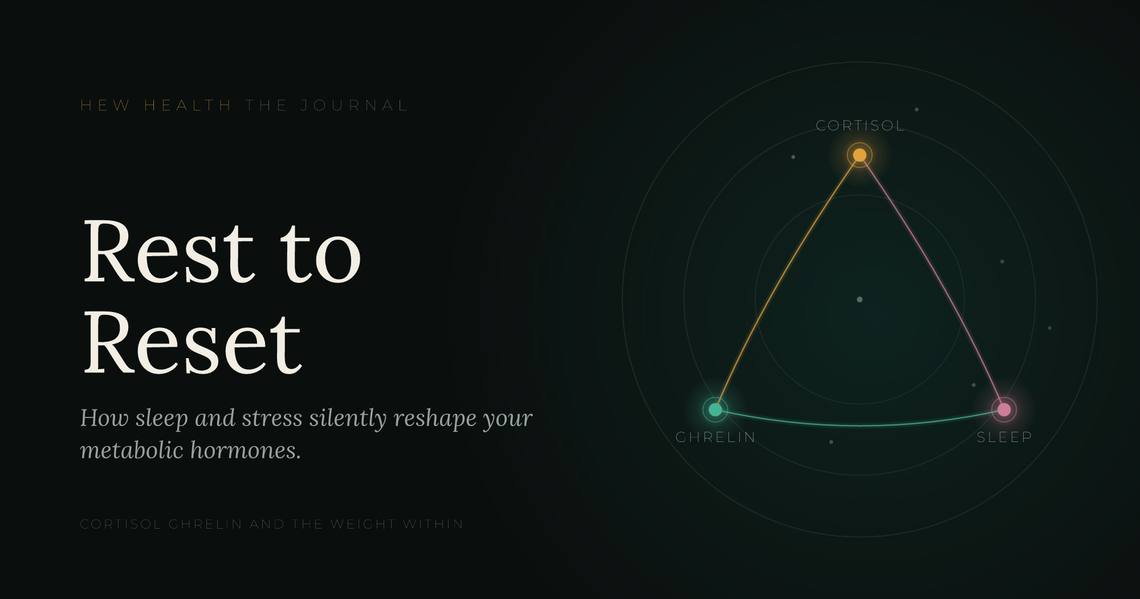
There is a feedback loop here worth naming. Poor sleep raises cortisol. Elevated cortisol disrupts sleep architecture. Each side worsens the other, and weight management becomes progressively harder the longer the cycle runs.
The Thyroid and Sex Hormones Get Pulled In Too
Chronic stress and sleep deprivation don't stay in one lane. The hypothalamic-pituitary axis coordinates most of your endocrine system, so when it is under pressure, downstream hormones shift as well.
Thyroid conversion, specifically the conversion of T4 to the more active T3, slows under chronic stress. Your TSH may look normal on labs, but you can still feel the effects of lower functional thyroid activity: cold hands, dry skin, stubborn weight, afternoon fatigue.
In women, cortisol competes with progesterone for shared precursors, which can worsen perimenopausal symptoms and disrupt the estrogen-progesterone balance that influences fat distribution and cravings. In men, chronic stress and poor sleep suppress testosterone production. Testosterone that dips into the low-normal range affects muscle mass, motivation to exercise, and insulin sensitivity, all of which matter for body composition. Hormone optimization can be part of the conversation when labs and symptoms line up, but the foundational work with sleep and stress usually comes first.
What Actually Moves the Needle
The interventions that help are not exotic. They are just harder to execute than most patients expect, because they require changing daily patterns rather than adding a supplement.
Protect Sleep Like a Prescription
Seven to eight hours in bed, with a consistent wake time, does more for metabolic health than almost any single dietary change. If you are getting six, adding thirty to sixty minutes is often the highest-yield intervention available to you. Practical anchors that tend to work:
- Fixed wake time seven days a week, including weekends. The wake time drives the sleep cycle more than bedtime does.
- Morning light exposure within thirty minutes of waking, ideally outside, ideally for ten minutes or more. This anchors your cortisol rhythm.
- Last meal three hours before bed. Late eating raises core body temperature and fragments sleep.
- Alcohol treated as a sleep disruptor, because that is what it is. Even two drinks measurably reduces REM and slow-wave sleep.
Address the Stress Load, Not Just the Symptoms
Meditation apps are fine, but they don't substitute for structural changes. Look at what is actually driving your stress and whether any of it is negotiable. Nervous system regulation practices (slow nasal breathing, zone-two cardio, strength training, time outdoors) shift you out of sympathetic dominance more reliably than trying to think your way calm.
Eat in a Way That Supports the Hormones You Have
Adequate protein at each meal (roughly 30 to 40 grams for most adults) stabilizes appetite hormones better than any macronutrient trick. Fiber from whole foods slows glucose response. Skipping meals when you are already cortisol-driven tends to backfire, because it raises cortisol further and often leads to compensatory eating at night.
Consider Whether Medical Support Fits
For some patients, lifestyle changes are necessary but not sufficient. Labs may show suboptimal thyroid conversion, low testosterone, insulin resistance, or a cortisol pattern that has been dysregulated for years. A thoughtful Weight Management plan may include GLP-1 medications when clinically appropriate, hormone optimization when labs and symptoms warrant it, and structured follow-up to adjust as your physiology responds. The goal is always to work with your biology rather than against it.
The Honest Summary
If you are struggling with weight in your forties or fifties, the problem is rarely that you lack discipline. More often, you are trying to out-discipline a hormonal environment shaped by years of short sleep, sustained stress, and the ordinary endocrine shifts that come with midlife. Fixing the substrate (sleep, stress, foundational nutrition) makes everything else you do work better. In many cases, it is also what allows medications and hormone optimization to deliver the results they are capable of.
If you would like a clinician's perspective on what is driving your specific situation, including targeted lab work and a plan built around your physiology rather than a template, request a consultation with our team.
Related from Hew Health