Beyond Fatigue: Five Biomarkers Your Hormone Optimization Provider Should Be Evaluating
Most people who walk into our practice asking about hormone optimization have already had a testosterone level checked somewhere. Sometimes an estradiol. Occasionally a TSH. The workup usually stops there, and the treatment plan is built on a single number. That approach misses most of the physiology that actually determines how you feel, how you respond to therapy, and how safely you can stay on it long term.
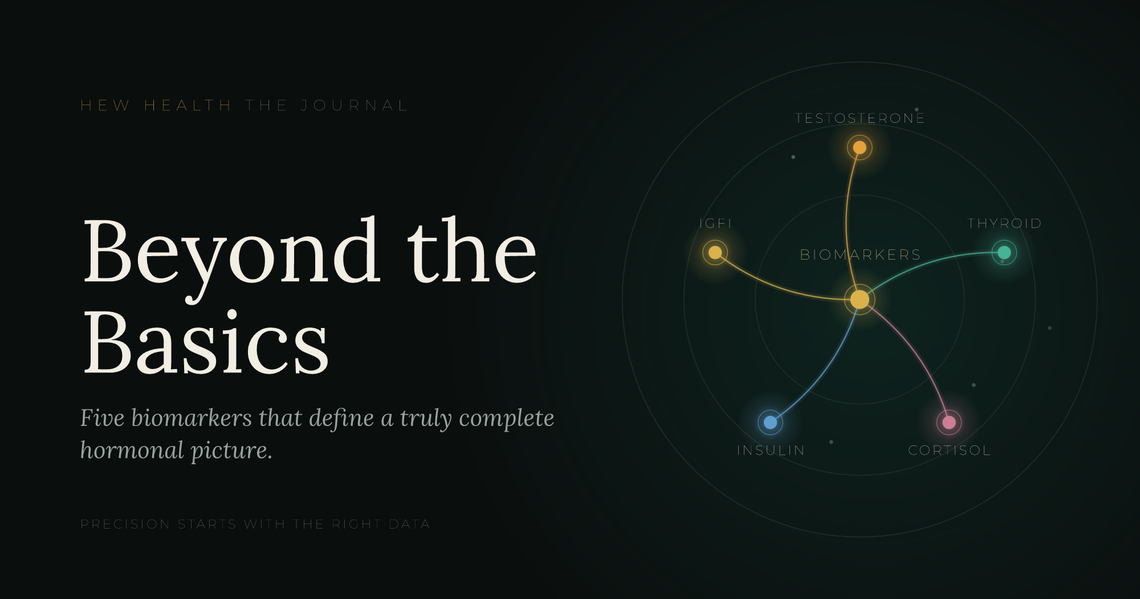
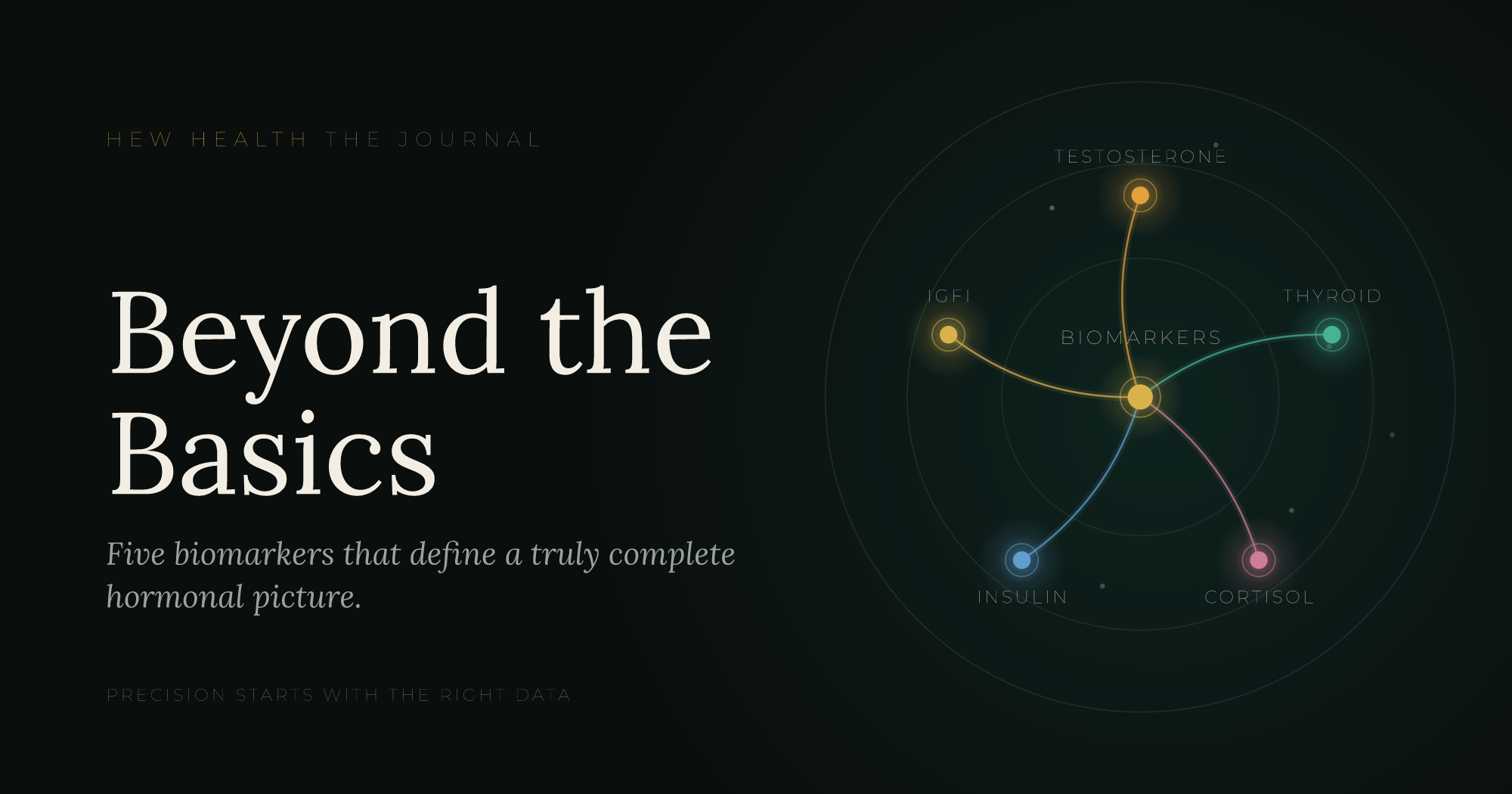
Hormones do not operate in isolation. They travel through binding proteins, convert into other hormones, interact with inflammatory signals, and are metabolized by the liver and kidneys. If you or your clinician are only looking at total testosterone or a single estradiol value, you are seeing perhaps a quarter of the picture. Below are five biomarkers we routinely evaluate at Hew Health, and the specific reasons each one matters.
1. Sex Hormone Binding Globulin (SHBG)
SHBG is the protein that binds testosterone and estradiol in the bloodstream. When hormones are bound to SHBG, they are largely unavailable to your tissues. Only the free fraction acts on receptors. This is why two patients with identical total testosterone levels can feel radically different: one may have an SHBG of 22 and abundant free hormone, the other an SHBG of 78 and almost nothing bioavailable.
SHBG shifts with insulin resistance (which pushes it down), thyroid status (hyperthyroidism drives it up), estrogen exposure, liver function, and aging. In men, low SHBG often accompanies metabolic syndrome and hepatic steatosis. In women, particularly in perimenopause, rising SHBG can mask a functional androgen deficiency even when total testosterone reads "normal."
Without SHBG, you cannot accurately calculate free testosterone, and you cannot dose intelligently. It is one of the least expensive labs in a hormone panel, and one of the most informative.
2. Estradiol (Measured by the Right Assay)
Estradiol matters in both sexes. In men on testosterone protocols, estradiol regulates bone density, libido, mood, joint comfort, and cardiovascular health. Suppress it too aggressively with an aromatase inhibitor and you produce joint pain, low libido, depressive symptoms, and lipid changes. Allow it to run unchecked and you can see gynecomastia, water retention, and emotional volatility.
The pitfall is the assay itself. Standard immunoassay estradiol testing was designed for premenopausal women with relatively high estrogen levels. It performs poorly at the lower ranges seen in men and postmenopausal women. We prefer LC-MS/MS (mass spectrometry) or a "sensitive estradiol" assay for accuracy. Making dose decisions from an inaccurate estradiol value is one of the most common errors we see in patients transferring care from other clinics.
3. A Full Thyroid Panel, Not Just TSH
TSH alone is not a thyroid evaluation. It is a pituitary signal, and it can look reassuring while free T3, the biologically active hormone, is inadequate at the tissue level. Patients with fatigue, cold intolerance, hair thinning, constipation, or stubborn weight often have a TSH within the reference range and free T3 sitting at the bottom of it.
A useful thyroid workup includes TSH, free T4, free T3, reverse T3, and thyroid antibodies (TPO and thyroglobulin). Reverse T3 rises during physiologic stress, illness, undereating, and inflammation, and it competes with active T3 at the receptor. Antibodies identify autoimmune Hashimoto's, which changes the trajectory of treatment considerably. Sex hormones and thyroid hormones influence each other directly. Estrogen raises thyroid binding globulin. Testosterone lowers it. You cannot optimize one axis while ignoring the other.
4. Fasting Insulin and Hemoglobin A1c
Metabolic health and hormonal health are the same conversation. Fasting glucose is a lagging indicator. By the time it drifts up, insulin has often been elevated for years, driving down SHBG in men, elevating androgens in women with PCOS, promoting visceral fat that aromatizes testosterone to estradiol, and disrupting sleep architecture in ways that further suppress the hypothalamic-pituitary-gonadal axis.
We look at fasting insulin alongside A1c and glucose to estimate insulin resistance early. A fasting insulin above roughly 10 µIU/mL, even with normal glucose, tells us the pancreas is working hard to keep numbers looking good. This finding changes the therapy conversation entirely, including whether Weight Management support belongs in the plan, how we structure nutrition guidance, and how we anticipate a patient's response to testosterone or estradiol therapy.
5. High-Sensitivity CRP and a Complete Lipid Panel with ApoB
Any serious hormone protocol requires cardiovascular literacy. Testosterone influences hematocrit, blood pressure, and lipid subfractions. Estradiol influences endothelial function and clotting. Before we prescribe, and periodically afterward, we want a clear cardiovascular baseline.
High-sensitivity CRP reflects systemic inflammation. Chronically elevated CRP is associated with accelerated atherosclerosis and often tracks with metabolic dysfunction, poor sleep, and visceral adiposity. ApoB, which counts the number of atherogenic particles circulating in your blood, is a more accurate cardiovascular risk marker than LDL cholesterol alone. Two patients with an LDL of 110 can have very different ApoB counts and very different actual risk.
These markers also let us track whether therapy is helping or harming the cardiovascular picture over time. Well-managed hormone optimization frequently improves inflammatory and lipid markers as body composition shifts and sleep improves. Poorly managed therapy can move them the wrong way. We want data, not assumptions.
What a Real Baseline Looks Like
When a new patient starts hormone optimization with us, the initial panel typically includes:
- Total and free testosterone, with SHBG and albumin for accurate calculation
- Sensitive estradiol (LC-MS/MS where possible)
- LH, FSH, and prolactin
- DHEA-S and cortisol (often a diurnal pattern in symptomatic patients)
- TSH, free T4, free T3, reverse T3, TPO and thyroglobulin antibodies
- Fasting glucose, fasting insulin, hemoglobin A1c
- Complete lipid panel with ApoB, plus hs-CRP
- CBC, comprehensive metabolic panel, ferritin, vitamin D, B12
- PSA in men over 40, and a discussion about breast and pelvic screening in women
The panel evolves based on symptoms and history. A woman in perimenopause with heavy cycles gets a different workup than a 52-year-old man with low morning energy and rising waist circumference. The point is that the numbers guiding your therapy should be broad enough to reveal the actual physiology, not narrow enough to fit a template.
Why This Matters for You
Hormone optimization done well is a longitudinal relationship with your physiology. Dose adjustments, symptom review, and repeat labs at defined intervals are how we keep therapy working for you rather than against you. The five biomarkers above (SHBG, sensitive estradiol, a full thyroid panel, fasting insulin with A1c, and hs-CRP with ApoB) are where the interesting information lives. They are also where preventable mistakes tend to originate when they are skipped.
If you are considering hormone optimization, or if you are already on a protocol and suspect your current workup is thinner than it should be, we would welcome the conversation. You can request a consultation with our team to review your history, your goals, and the labs that will actually tell us what is happening.
Related from Hew Health