How Thyroid Function Fits Into Your Hormone Optimization Plan
When patients come to us frustrated by fatigue, stubborn weight, thinning hair, or a mood that feels one shade off, they often expect the conversation to center on testosterone, estrogen, or progesterone. Those matter. But in my experience, if we skip a careful look at the thyroid, we end up chasing symptoms that never fully resolve. The thyroid sits upstream of nearly every metabolic process the sex hormones influence, and ignoring it is like tuning a piano without checking whether the room is warped.
Here is how we think about the thyroid inside a broader hormone optimization plan, and why the standard "your TSH is normal" answer often misses the point.
What the Thyroid Actually Does
The thyroid is a small butterfly-shaped gland in the front of your neck, and it sets the pace of your cellular metabolism. It produces mostly T4 (thyroxine), a storage form, which your tissues then convert into T3 (triiodothyronine), the active hormone that drives energy production inside your mitochondria. A smaller amount of T3 is secreted directly. Reverse T3, an inactive metabolite, acts as a brake.
Every cell in your body has thyroid receptors. That is why suboptimal thyroid function shows up as such a wide constellation of symptoms: cold hands, dry skin, constipation, brain fog, low libido, high cholesterol, slow heart rate, heavy periods, joint stiffness, hair that sheds in the shower. Patients often describe it as "running at 80 percent" without being able to say why.
Why "Normal" TSH Is Not the Full Story
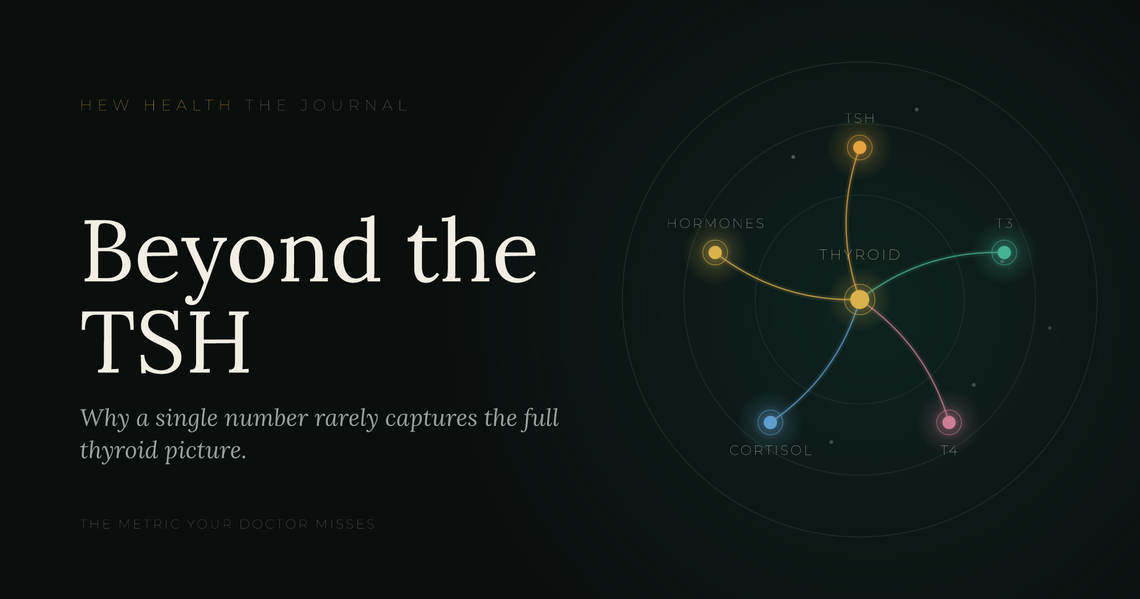
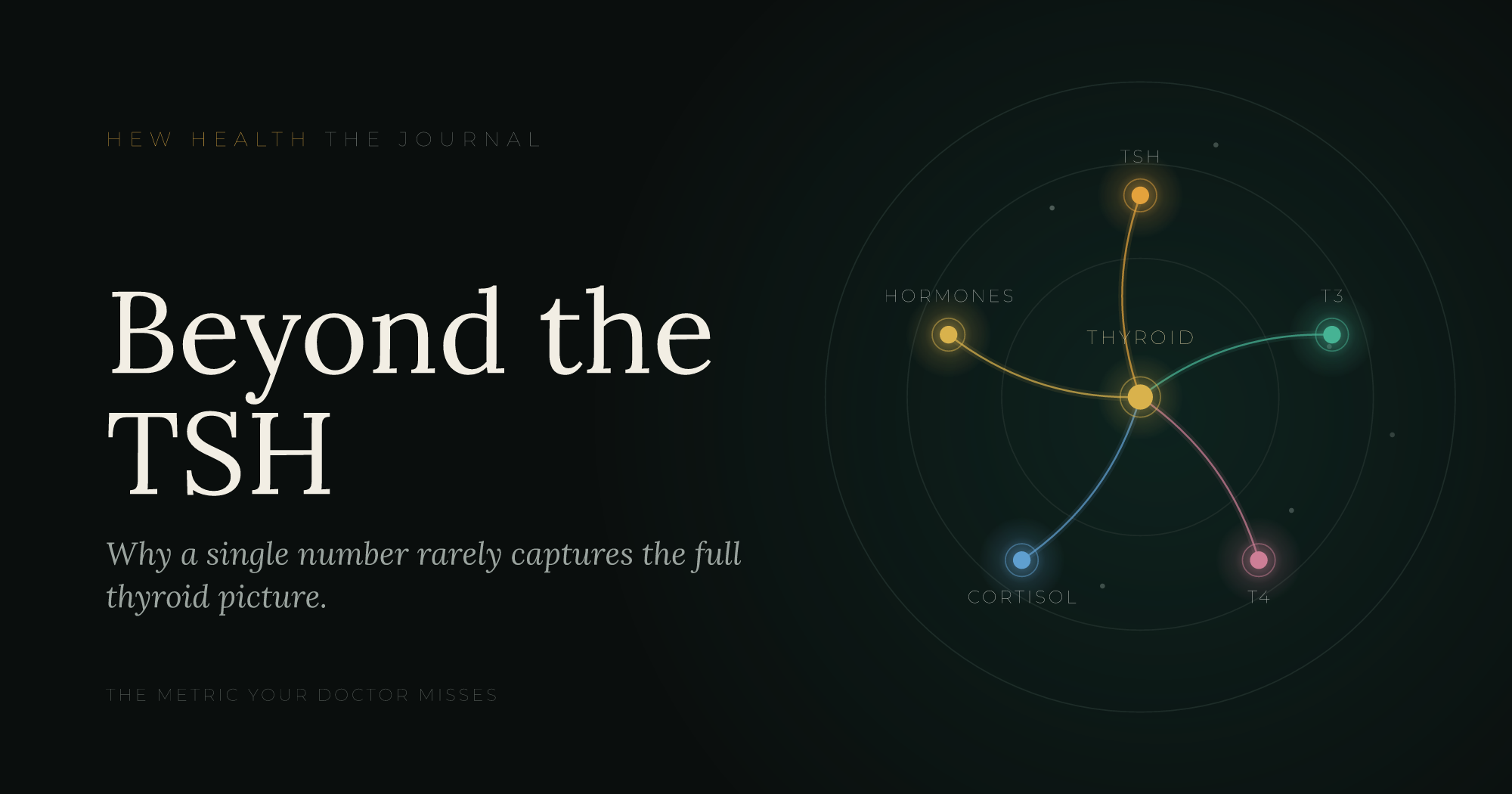
Most primary care visits screen thyroid function with a single TSH (thyroid-stimulating hormone) value. TSH is a pituitary signal, not a thyroid hormone itself. It tells you what your brain is asking the thyroid to do, not what the thyroid is actually producing or what your tissues are receiving.
Reference ranges for TSH typically run from roughly 0.4 to 4.5 mIU/L in the U.S., but a person with a TSH of 3.8 can feel meaningfully different from a person at 1.2, even though both fall inside the range. In our practice we order a fuller panel:
- TSH
- Free T4
- Free T3
- Reverse T3
- Thyroid peroxidase antibodies (TPO) and thyroglobulin antibodies
That combination lets us see production, conversion, and whether the immune system is quietly attacking the gland. Hashimoto's thyroiditis, the autoimmune driver behind most hypothyroidism in this country, can be present for years with antibodies elevated before TSH ever drifts out of range. Catching that early changes the plan.
The Sex Hormone Connection
Thyroid and sex hormones are constantly talking to each other, and this is where hormone optimization gets interesting.
Estrogen raises thyroid-binding globulin, the protein that carries thyroid hormone in the blood. When binding globulin goes up, less free (usable) thyroid hormone reaches your tissues. Women starting oral estrogen sometimes develop hypothyroid symptoms even though their total T4 looks fine on paper. This is one reason we look at the free fractions.
Progesterone, on the other hand, tends to support thyroid receptor sensitivity. Women in perimenopause who lose progesterone earlier than estrogen often notice thyroid-type symptoms creeping in a year or two before their cycles become obviously irregular.
Testosterone influences thyroid function too. In men with low testosterone, we frequently see borderline low free T3 and higher reverse T3, particularly if there is metabolic syndrome or poor sleep in the mix. Addressing one hormone without checking the other leaves results on the table.
Cortisol matters as well. Chronic stress elevates reverse T3, effectively putting the brake on your metabolism even when TSH and T4 look fine. This is a common pattern in high-achieving patients in their 40s and 50s who cannot understand why they feel depleted despite "normal" labs.
Symptoms We Take Seriously
A patient does not need every symptom on the classic list to warrant a thorough workup. The ones that most reliably prompt us to look harder:
- Persistent morning fatigue despite adequate sleep
- Weight that will not move despite disciplined eating and exercise
- Cold intolerance, especially cold hands and feet
- Hair thinning at the outer eyebrows or diffuse shedding
- Constipation that is new or worsening
- Elevated LDL cholesterol without a clear dietary explanation
- Mood changes that feel more flat than anxious
- Menstrual changes, particularly heavier or longer periods
Any two or three of these together, especially with a family history of thyroid disease, deserve a fuller panel.
How We Approach Treatment
If labs and symptoms point to hypothyroidism, treatment is individualized. Some patients do well on levothyroxine (synthetic T4) alone, particularly if their conversion to T3 is efficient. Others need a combination approach with T3 added, or a natural desiccated thyroid preparation that contains both. The right choice depends on your free T3, your reverse T3, your symptoms, and how you respond over time.
We generally recheck labs six to eight weeks after any dose change, because thyroid hormone has a long half-life and steady state takes time. Dosing is titrated to how you feel and how your labs move, not to a single target number.
For patients with Hashimoto's, we also look at the drivers of the autoimmunity itself: gluten sensitivity in a subset, selenium and iodine status, vitamin D, gut health, and stress load. Slowing the immune attack matters as much as replacing the hormone.
Integrating Thyroid Care With Your Broader Plan
When thyroid function is optimized alongside a hormone optimization protocol, patients typically notice the pieces reinforcing each other. Sleep improves, which lowers reverse T3. Body composition shifts, which improves insulin sensitivity and reduces the inflammatory pressure on the thyroid. Sex hormones work better at the receptor level when metabolic rate is where it should be. The gains compound.
This is also why we do not treat thyroid in isolation. A woman on estrogen and progesterone through menopause may need her thyroid dose adjusted when she starts hormone optimization, because binding proteins shift. A man starting testosterone may see his free T3 improve without any thyroid intervention at all, as sleep quality and body composition change. These are moving parts, and they should be managed together by someone watching all of them.
What to Do Next
If you have been told your thyroid is "fine" but you still feel off, or if you are considering hormone optimization and want a complete picture before starting, a thorough thyroid evaluation belongs in the conversation. Bring your prior labs. Bring your symptom list. We will look at the whole panel and, more importantly, at you.
To discuss your situation with a physician who will take the time to look carefully, request a consultation with our team.
Related from Hew Health