Emerald Coast Concierge IV Therapy: Hydration and Nutrient Repletion at Crab Island, Destin, and Fort Walton Beach
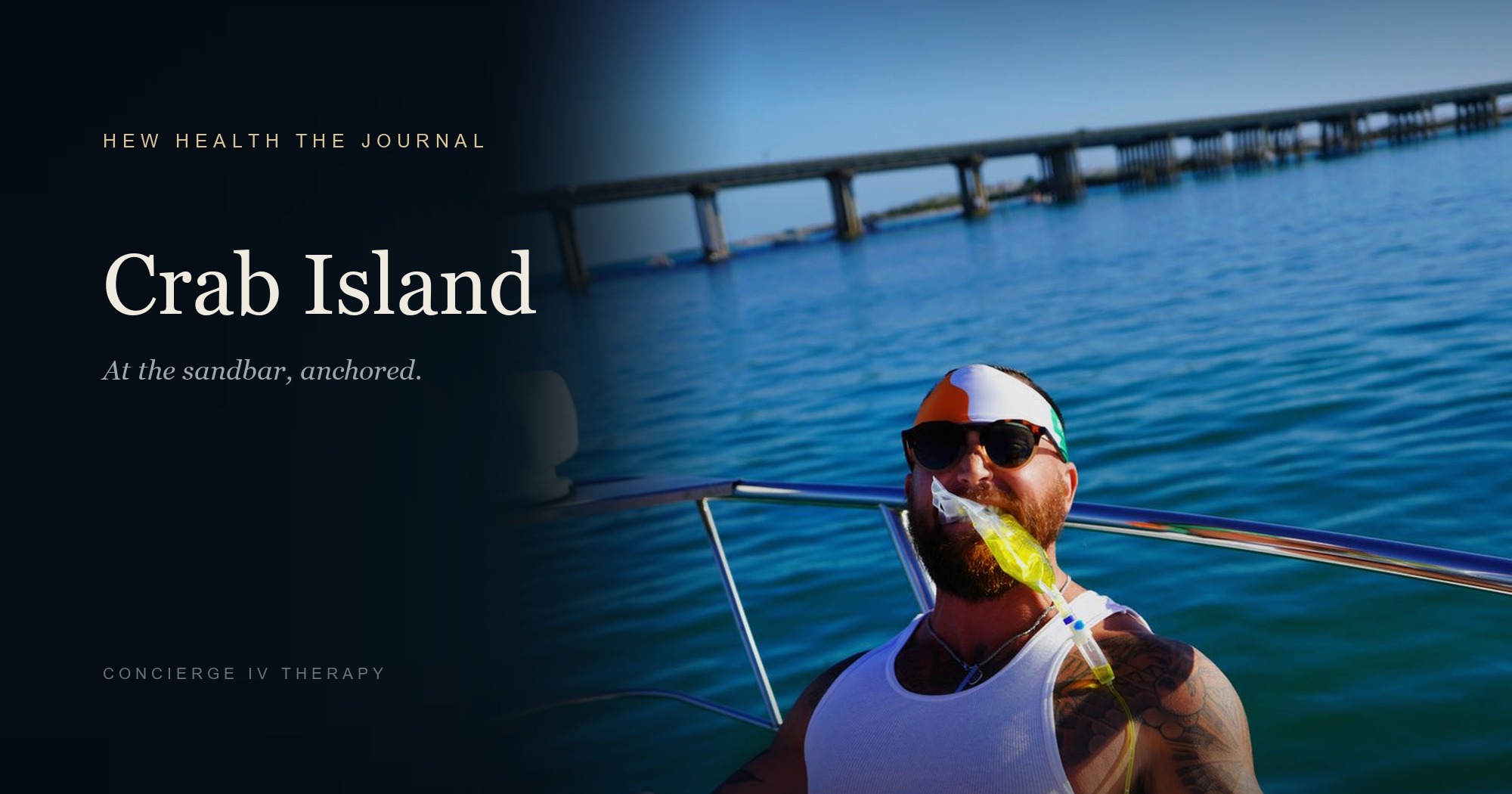
By early afternoon at Crab Island, the sun has done real work on you. Salt on your skin, sand in the cooler, three hours since your last full glass of water. You feel it in your temples and in that flat, wrung-out feeling that no amount of light beer is going to fix. This is where a lot of our concierge IV visits happen: boat anchored on the sandbar, engine off, a licensed nurse stepping aboard with a cooler of fluids and supplies.
Hew Health runs concierge IV therapy across the Emerald Coast, from 30A west through Miramar Beach, Destin, Fort Walton Beach, and out to Navarre. We come to rental condos, beach houses, hotel rooms, boats at the slip, and in summer, to Crab Island itself. What follows is a practical look at how it works, what hydration and nutrient repletion actually do, and how we keep it safe when the setting is a boat deck instead of a clinic room.
Why Crab Island is hard on your hydration
The Gulf sun off Destin runs high UV from late morning through late afternoon. Add radiant heat from the water, wind that quietly evaporates sweat before you notice it, and the diuretic effect of alcohol, and you have the classic setup for volume depletion. You are losing more fluid than you realize, and you are losing sodium, potassium, magnesium, and chloride with it.
The symptoms most people describe to our nurses on the sandbar are familiar: headache behind the eyes, nausea when they stand up from the swim platform, a heavy fatigue that started around lunch, muscle cramps in the calves, and that particular kind of irritability that comes from being cooked. Oral hydration helps, but absorption through the gut is slow and capped by how fast your stomach empties. Intravenous fluid bypasses that bottleneck. A liter of balanced electrolyte solution goes into circulation in roughly 30 to 45 minutes, and you feel the difference before the bag is empty.
To be clear about what this is: IV hydration and vitamin therapy is wellness support, not treatment for a medical condition. If you are sick, you need a physician, not a drip.
What a concierge visit actually looks like
You call or text, tell us where you are (a condo in Miramar Beach, a house on 30A, a boat at HarborWalk, a pontoon anchored on the east side of the sandbar), and we dispatch a registered nurse. Every drip is reviewed by a provider before it is mixed, and a licensed RN places the IV and stays with you through the infusion.
On arrival the nurse takes a brief history and vitals: blood pressure, heart rate, oxygen saturation, a look at your hydration status. You talk through what you have been doing, what you have eaten, what medications you take, and what you are hoping to feel like when the bag is empty. The IV goes in, usually in the forearm or the back of the hand, and the fluid runs by gravity. Most visits take about 45 to 60 minutes from knock to goodbye.
On the water, the rules are stricter. The boat must be anchored and the engine shut down. We do not start an IV on a vessel that is under way, period. If conditions on the sandbar are rough, we reschedule or move the visit to your condo or hotel. A needle and a rolling deck do not mix.
What goes in the bag
The base is almost always a balanced crystalloid, either normal saline or lactated Ringer's, chosen based on your history and what you need. From there, the nurse can add components a provider has approved for your visit:
- B-complex vitamins, including B12, for repletion after a long day of exertion and limited eating
- Vitamin C at wellness doses
- Magnesium, which many people run low on and which can help with the muscle tightness that follows a day of swimming and sun
- Zinc
- Anti-nausea medication when appropriate and cleared by the provider
- An analgesic for headache when appropriate and cleared by the provider
None of this cures anything. What it does is restore intravascular volume and replete water-soluble vitamins and electrolytes that get depleted during a long, hot day outdoors. Most people describe feeling clearer-headed and less physically wrecked within the hour. That is the honest description of what fluid and electrolytes do.
Who we cannot treat, and why
Concierge IV is a great fit for healthy adults who are dehydrated, tired, and want to feel functional again. It is not appropriate for everyone, and our nurses will decline a visit when the situation calls for it. Specifically:
- Anyone visibly intoxicated. We cannot obtain meaningful consent, and alcohol changes how your cardiovascular system responds to a fluid bolus.
- Pregnant patients without OB clearance.
- Anyone with a heart, kidney, or liver condition that has not been cleared for IV fluids by their physician. A liter of saline is not trivial in a patient with heart failure or advanced kidney disease.
- Anyone the nurse judges to be medically unstable at the bedside. In that case we help you get to an appropriate level of care.
This is not us being difficult. It is us doing the job properly. The value of a concierge medical service is that a clinician is actually making clinical judgments in your living room or on your boat, not just running a product.
Where we go
Our service area covers the length of the Emerald Coast most visitors and residents actually use. That includes the 30A corridor (Rosemary Beach, Alys, Seaside, Grayton, Blue Mountain, Dune Allen), Miramar Beach and Sandestin, Destin proper including HarborWalk and the residential neighborhoods off Airport Road, Okaloosa Island, Fort Walton Beach, and west to Navarre. In summer we add Crab Island itself, weather and sea state permitting.
For rental groups, the logistics are simple. Send us the address, the gate code if there is one, and a working cell number. For boats, send us the slip number or, if you are already anchored at the sandbar, a pin drop and a description of the boat. Our nurse will find you.
Getting the most out of a visit
A few practical notes from what we see on the coast:
Book earlier in the day than you think. People tend to wait until they feel awful, then want an IV at 9 pm. We are happy to come, but you will feel better faster if you address volume depletion before it turns into a full headache and nausea spiral. If you know you have a big day on the water planned, a morning visit at the condo before you leave the dock is often the smarter play.
Eat something. IV fluid replaces water and electrolytes. It does not replace calories or protein. A real meal alongside the drip helps you actually recover.
Keep drinking water afterward. The IV gets you back to baseline. Staying there is on you.
Tell the nurse the truth about what you drank, what you took, and how you feel. Everything is confidential, and it changes what we recommend.
Ready when you are
Concierge IV therapy is one of the more straightforward things we do at Hew Health, and one of the most appreciated by people who came to the Emerald Coast to enjoy it, not to spend an afternoon feeling terrible in a rental condo. If you want to see how concierge IV therapy works in Crab Island, the page has the details and the number to call or text. There is no booking form; a real person answers, and a nurse comes to you.
Whether you are on a boat at the sandbar, a balcony in Miramar Beach, or a house on 30A, the model is the same. A provider reviews your drip, a licensed RN places it, and we treat the visit like the medical encounter it is.
Related from Hew Health