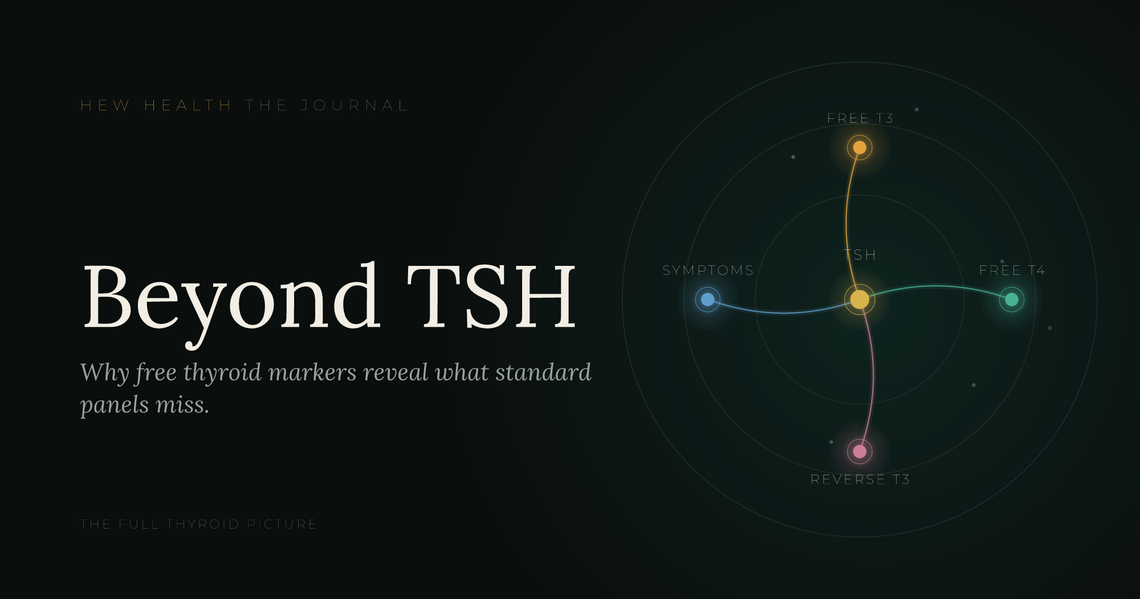
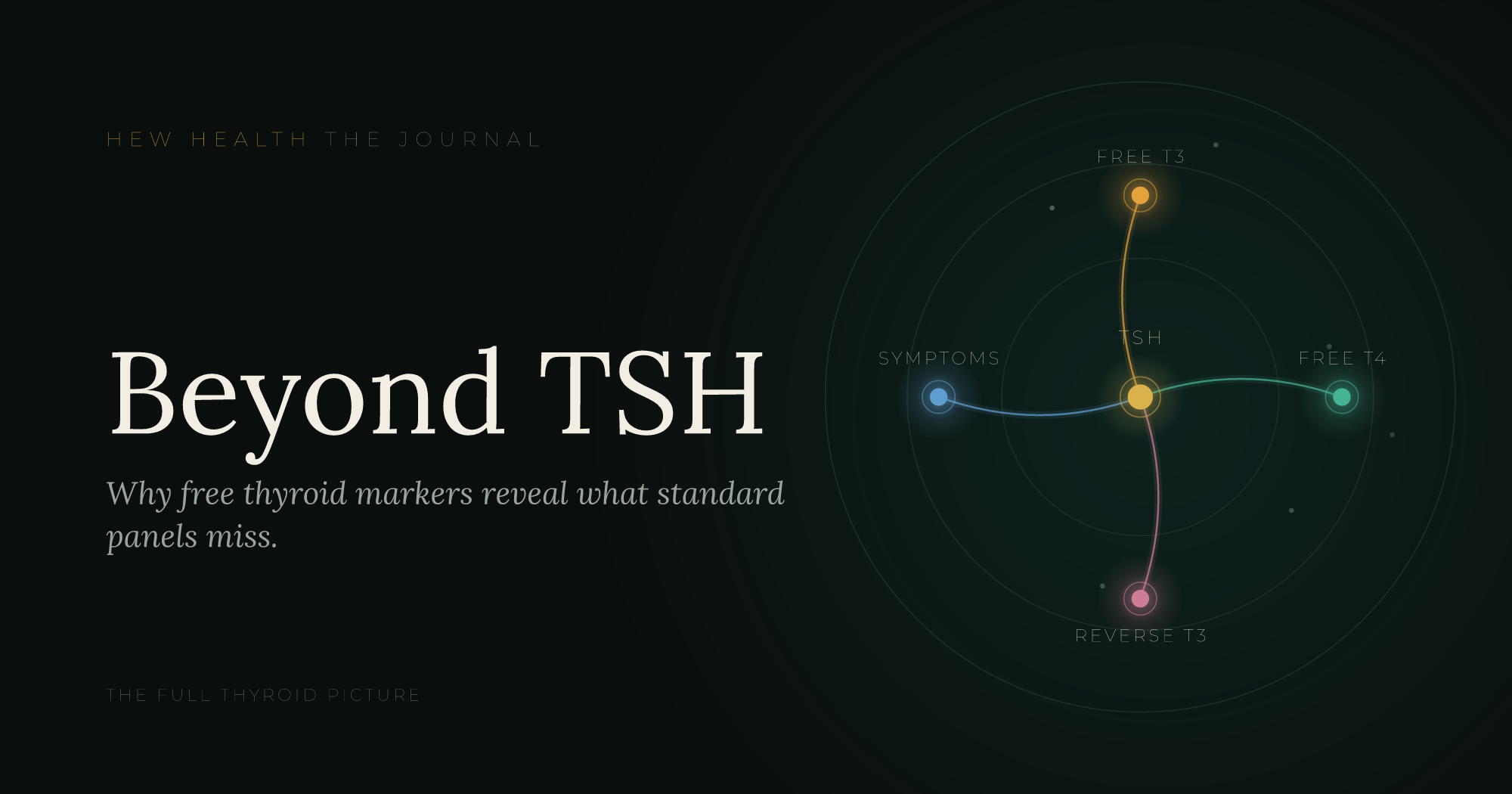
Thyroid Function and Hormone Optimization: Why T3 and T4 Levels Matter More Than You Think
A patient came in last month convinced she was losing her mind. Forty-three years old, runs a small architecture firm, used to swim a mile three mornings a week. Now she was sleeping nine hours and waking exhausted, gaining weight on the same diet she had eaten for a decade, and forgetting client names mid-sentence. Her primary care doctor had run a TSH, told her it was "normal," and suggested an antidepressant. Her free T3 turned out to be in the bottom 5% of the reference range.
This is one of the most common stories I hear in our practice. The thyroid sits at the center of how you feel, how you think, how you metabolize food and medications, and how your sex hormones actually do their work. When we talk about hormone optimization, leaving the thyroid out of the conversation is a bit like tuning a piano and ignoring the middle octave.
What the Thyroid Actually Does
Your thyroid produces two main hormones: T4 (thyroxine) and a smaller amount of T3 (triiodothyronine). T4 is largely a storage and transport form. T3 is the active hormone that binds to receptors in nearly every cell in your body and tells those cells how fast to run their machinery. Mitochondrial output, body temperature, cholesterol clearance, gut motility, cognitive speed, hair growth, menstrual regularity, libido. All of it is downstream of T3.
The conversion from T4 to T3 happens mostly in the liver, gut, and peripheral tissues, mediated by enzymes called deiodinases. This conversion step is where a lot of people get into trouble, and it is invisible on a standard TSH test.
Why TSH Alone Misses People
TSH (thyroid stimulating hormone) is what the pituitary releases to tell the thyroid to make more hormone. Most labs flag TSH as abnormal only above roughly 4.5 mIU/L. The problem is that the reference range was built from a population that included a lot of people with undiagnosed thyroid dysfunction, which inflates the upper limit. Several endocrinology groups have argued for years that the true healthy range tops out closer to 2.5.
More importantly, TSH tells you what the pituitary thinks is happening. It does not tell you what your cells are actually receiving. You can have a TSH of 1.8 and a free T3 that is barely scraping the bottom of the range because your conversion is poor. You will feel awful, and your labs will look "fine."
In our practice, a complete thyroid workup includes:
- TSH
- Free T4
- Free T3
- Reverse T3
- Thyroid peroxidase (TPO) and thyroglobulin antibodies
That last pair matters because Hashimoto's thyroiditis is the most common cause of hypothyroidism in the United States, and antibodies can be elevated for years before TSH ever shifts. Catching it early changes the conversation entirely.
The Reverse T3 Problem
Reverse T3 is structurally similar to T3 but biologically inactive. Think of it as a hormone that fits the lock but does not turn the key. Under stress, illness, calorie restriction, inflammation, or high cortisol, your body shunts more T4 into reverse T3 instead of active T3. The ratio of free T3 to reverse T3 is, in my experience, one of the most clinically useful numbers in a hormone panel.
I have seen patients with normal TSH, normal free T4, low-normal free T3, and a reverse T3 sitting at the top of the range. They feel terrible and no one can tell them why. Addressing the underlying drivers (sleep debt, chronic dieting, untreated sleep apnea, gut inflammation) often does more than any prescription.
How Thyroid Interacts With Sex Hormones
This is where things get interesting for anyone in their 40s or 50s noticing changes. Thyroid hormone influences sex hormone binding globulin (SHBG), which determines how much of your testosterone and estradiol is free and biologically available. Low thyroid output tends to drive SHBG down, which can mask declining testosterone on a total testosterone reading. Estrogen, in turn, increases thyroid binding globulin, which can make your free T4 look lower during pregnancy, oral contraceptive use, or estrogen therapy.
Progesterone and thyroid have a bidirectional relationship as well. Women in perimenopause with falling progesterone often see their thyroid symptoms intensify, and women on thyroid medication sometimes need dose adjustments once we begin optimizing other hormones. None of these systems operate in isolation. Treating one without watching the others usually backfires.
Symptoms That Should Prompt a Closer Look
The classic teaching is cold intolerance, weight gain, constipation, dry skin, and hair loss. Those are real, but the subtler presentations are more common in midlife:
- Cognitive fog that does not respond to better sleep
- Stubborn LDL cholesterol despite a clean diet
- Resting heart rate that has drifted downward into the high 40s with no training to explain it
- Outer third of the eyebrows thinning
- Heavy or irregular menstrual cycles in women still cycling
- Erectile changes or loss of morning erections in men, often attributed solely to testosterone
- Persistent muscle aches that get blamed on a statin
None of these are diagnostic on their own. Patterns matter, and so does context.
Treatment Is Not One-Size
The default treatment for hypothyroidism in this country is levothyroxine, which is synthetic T4. For roughly two-thirds of patients, that works well. Their conversion is intact, they feel like themselves again, and we move on. The other third do not respond fully. Their TSH normalizes but their symptoms persist, and their free T3 stays stubbornly low.
For those patients, we may consider adding synthetic T3 (liothyronine), using a combination product, or in selected cases natural desiccated thyroid. The decision depends on lab patterns, cardiac history, age, and what someone has already tried. T3 is more potent and shorter-acting, so dosing requires care, particularly in anyone with atrial fibrillation risk or osteoporosis.
Equally important is what we address alongside medication. Selenium and zinc are cofactors for deiodinase enzymes. Iron deficiency impairs conversion. Chronic undereating, particularly low carbohydrate intake combined with intense training, will tank T3 in otherwise healthy people. Untreated sleep apnea is a thyroid stressor we still underdiagnose, especially in women.
What Good Care Looks Like
If you are being followed for thyroid issues, your labs should be drawn at a consistent time of day, ideally before you take your medication. Dose changes generally need six to eight weeks before retesting, because that is how long it takes the system to find its new equilibrium. Biotin supplements (often in hair and nail formulas) can interfere with thyroid assays, so we ask patients to stop them for several days before a blood draw.
Your clinician should be asking how you actually feel, not just chasing a number. A TSH of 1.2 means very little if you are sleeping ten hours and still falling asleep at your desk. Conversely, plenty of people feel terrific with a TSH at 3.0 and need no intervention at all.
The Bigger Point
Thyroid function is the quiet variable in almost every hormone conversation I have. Patients come in asking about testosterone, estrogen, progesterone, peptides, or weight management, and we end up finding that their thyroid has been undertreated or never properly evaluated. Fixing that often makes everything else work better, and sometimes it makes the other interventions unnecessary.
If you have been told your thyroid is fine but you do not feel fine, the answer is rarely an antidepressant or a stricter diet. It is usually a more complete workup and a clinician willing to look at the whole picture. If that sounds like the conversation you have been wanting to have, request a consultation with our team and we will take it from there.
Related from Hew Health