The Role of Thyroid Function in a Comprehensive Hormone Optimization Protocol
Most conversations about hormone optimization start with testosterone or estrogen. In our practice, we often see patients who have already been down that road, feel somewhat better, and yet still complain of stubborn fatigue, cold hands, thinning hair, or a stalled metabolism. When we look closer, the thyroid is usually the piece that was measured superficially or missed entirely.
The thyroid is not a stand-alone organ. It sits inside a feedback loop with the hypothalamus, pituitary, adrenals, and gonads, and it responds to everything from sleep debt to iron stores to how much protein you ate yesterday. Optimizing one hormone without understanding thyroid status is a bit like tuning an engine while ignoring the fuel pump.
Why a "Normal" TSH Isn't the Whole Picture
When patients bring in prior labs, nine times out of ten the workup consisted of a single TSH, occasionally paired with a Free T4. If both fell inside the reference range, they were told their thyroid was fine. The problem is that TSH is a pituitary hormone, not a thyroid hormone. It tells us what the brain is asking for, not what the tissues are receiving.
A meaningful thyroid evaluation looks at the whole cascade:
- TSH, with attention to where in the range it sits, not just whether it is "in range."
- Free T4, the storage form produced by the gland.
- Free T3, the active hormone that actually binds receptors and drives metabolism.
- Reverse T3, which competes with T3 at the receptor and rises with stress, illness, and caloric restriction.
- Thyroid antibodies (TPO and thyroglobulin), which can flag autoimmune thyroiditis years before TSH shifts.
We frequently see patients with a TSH of 2.8, a Free T4 in the middle of the range, and a Free T3 sitting at the bottom with elevated reverse T3. On paper, they look fine. Symptomatically, they feel anything but.
The Conversion Problem
T4 is largely inactive. Your body converts it to T3 in the liver, gut, kidneys, and peripheral tissues, using enzymes that depend on selenium, zinc, iron, and adequate cortisol (though not too much). Anything that stresses the system, whether chronic dieting, poor sleep, heavy training without recovery, inflammation, or elevated cortisol, can shunt T4 toward reverse T3 instead of active T3.
This is why a patient can produce plenty of T4 and still feel hypothyroid at the cellular level. It is also why simply prescribing more T4 (levothyroxine) sometimes fails to resolve symptoms. If the conversion machinery is broken, adding more raw material does not fix the assembly line.
How Thyroid Interacts with Sex Hormones
Thyroid function and sex hormones are deeply intertwined, and ignoring one distorts the other.
Estrogen increases thyroid-binding globulin, which lowers the free (usable) fraction of thyroid hormone. Women starting hormone optimization protocols involving estrogen may find their previously adequate thyroid dose is suddenly insufficient. We watch for this and retest at six to eight weeks.
Testosterone tends to lower thyroid-binding globulin, which can raise free thyroid levels. Men beginning testosterone protocols occasionally report a subtle increase in warmth, appetite, or resting heart rate that traces back to shifting thyroid availability rather than the testosterone itself.
Progesterone appears to support thyroid function at the receptor level, and low progesterone in perimenopause often coincides with worsening thyroid symptoms even when labs look stable.
Cortisol is the referee. Both too much (chronic stress, undiagnosed Cushing's) and too little (adrenal insufficiency, over-restricted living) impair T4-to-T3 conversion and blunt receptor sensitivity. Any serious thyroid workup includes a look at adrenal rhythm.
Symptoms That Point Us Toward the Thyroid
The classic textbook picture (weight gain, cold intolerance, constipation, dry skin, hair loss, bradycardia) still holds, but in real practice the presentation is usually more subtle in adults between 35 and 58. Patients describe:
- Fatigue that coffee no longer touches, particularly mid-afternoon.
- Difficulty losing body fat despite disciplined eating and training.
- Brain fog and word-finding trouble that they attribute to age or perimenopause.
- Hair thinning at the temples or outer eyebrows.
- Cold hands and feet, or needing socks to bed while a partner runs warm.
- Elevated cholesterol that appeared without a diet change.
- Menstrual irregularity or worsening PMS in women who previously had neither.
Any one of these in isolation could mean many things. Two or three together, especially with a family history of thyroid or autoimmune disease, warrants a complete panel.
What a Thoughtful Protocol Looks Like
Treating thyroid dysfunction within a broader hormone optimization plan is a matter of sequence and precision. A few principles guide how we approach it.
Address the foundation first. Iron, ferritin, vitamin D, B12, and selenium all influence thyroid function. We correct deficiencies before assuming a patient needs prescription thyroid support. A ferritin of 22 can mimic hypothyroidism convincingly.
Match the medication to the physiology. Levothyroxine (T4 only) works well for patients who convert efficiently. For those who do not, adding liothyronine (T3) or using a combination product can restore active hormone levels. This is a clinical decision based on labs and symptoms, not a one-size preference.
Retest at the right intervals. Thyroid changes are not immediate. We generally retest six to eight weeks after any dose adjustment, and again after any change to estrogen or testosterone dosing, because the interaction is real.
Watch the whole patient. Resting heart rate, basal body temperature, sleep quality, bowel regularity, and menstrual patterns are data. Labs anchor the plan, but the person in front of us decides whether it is working.
Autoimmune Thyroid Disease Deserves Its Own Attention
Hashimoto's thyroiditis is the most common cause of hypothyroidism in the United States, and it is frequently diagnosed years after antibodies first appear. If a patient has elevated TPO antibodies with a still-normal TSH, we do not simply wait for the gland to fail. We look at gluten sensitivity, gut health, vitamin D status, and stress load, and we retest at intervals. Early identification changes the trajectory.
Graves' disease and other hyperthyroid states are less common but need prompt recognition, particularly in patients on testosterone or stimulant medications where symptoms can be masked or attributed elsewhere.
Where Thyroid Fits in the Bigger Picture
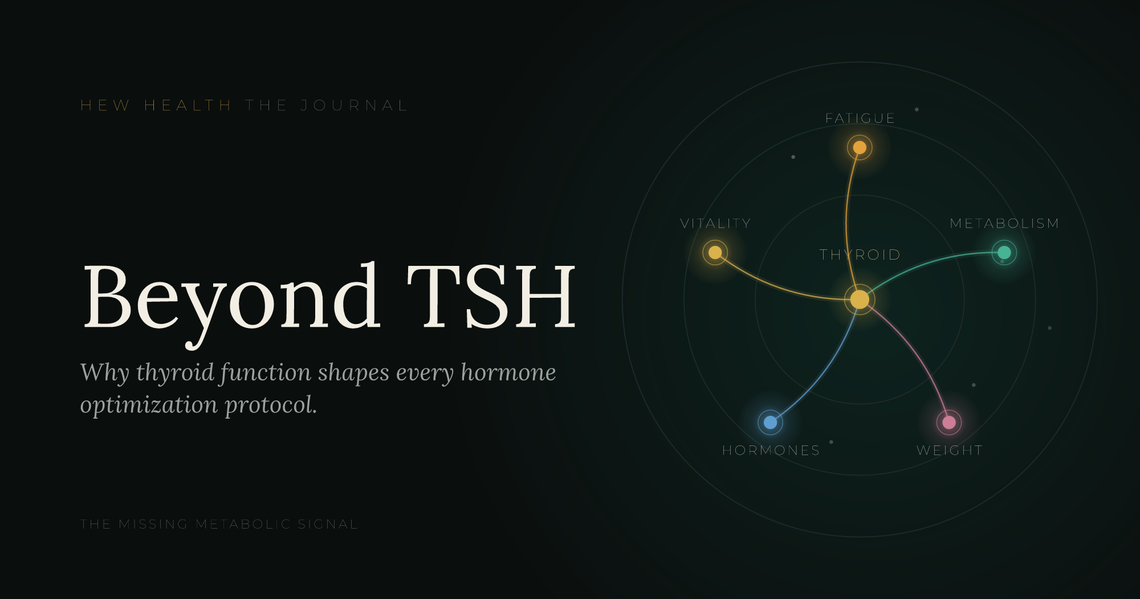
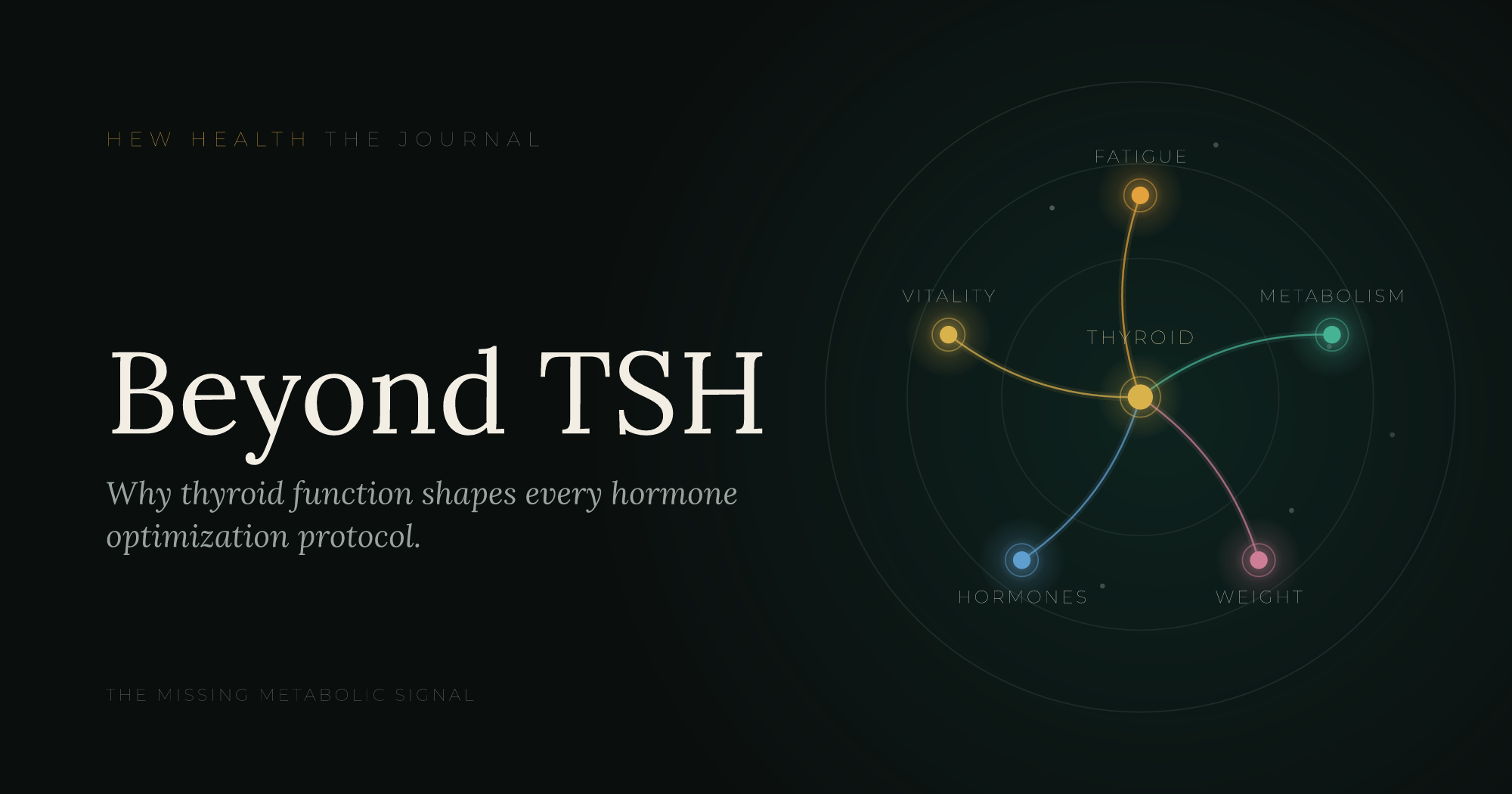
Hormone optimization is a systems problem. Testosterone without adequate thyroid support underperforms. Estrogen dosing without accounting for thyroid-binding globulin becomes a moving target. Weight Management protocols stall when free T3 is low. Sleep, mood, libido, and cognitive sharpness all draw on thyroid function directly or through its effect on other hormones.
When we build a protocol for a patient, thyroid is not an afterthought or a separate track. It sits at the center of the panel with the same weight as the sex hormones, and we adjust it with the same care.
If you have been told your thyroid is "normal" but you still do not feel like yourself, or if you are considering a comprehensive hormone optimization plan and want it done thoroughly, request a consultation with our team and we will take a proper look.
Related from Hew Health