Thyroid Function and Hormone Optimization: What Your Standard Bloodwork May Be Missing
If you've been told your thyroid is "normal" but you still feel cold, tired, foggy, and twenty pounds heavier than you should be, you are not imagining things. In our practice, this is one of the most common reasons people end up seeking a second opinion. Their bloodwork came back fine. Their primary care physician was reassuring. And yet something is clearly off.
The problem is rarely the patient. The problem is usually the panel.
What a Standard Thyroid Panel Actually Measures
When most physicians order "thyroid labs," they order a single test: TSH (thyroid stimulating hormone). TSH is a pituitary hormone, not a thyroid hormone. It tells you how loudly the brain is shouting at the thyroid gland. If the brain is shouting, the assumption is that the thyroid is underperforming. If it's quiet, the assumption is that everything downstream must be working.
That assumption falls apart in a lot of real-world situations. TSH can look perfectly normal while the actual thyroid hormones in your bloodstream are low. It can look normal while your cells are unable to use the hormone you do produce. And the reference range itself is wide enough to drive a truck through. Most labs flag TSH as abnormal only above roughly 4.5 mIU/L, even though many endocrinology groups have argued for years that anything above 2.5 warrants a closer look, particularly in symptomatic patients.
So you can be biochemically "normal" and clinically miserable. Both things can be true at the same time.
The Tests That Usually Get Skipped
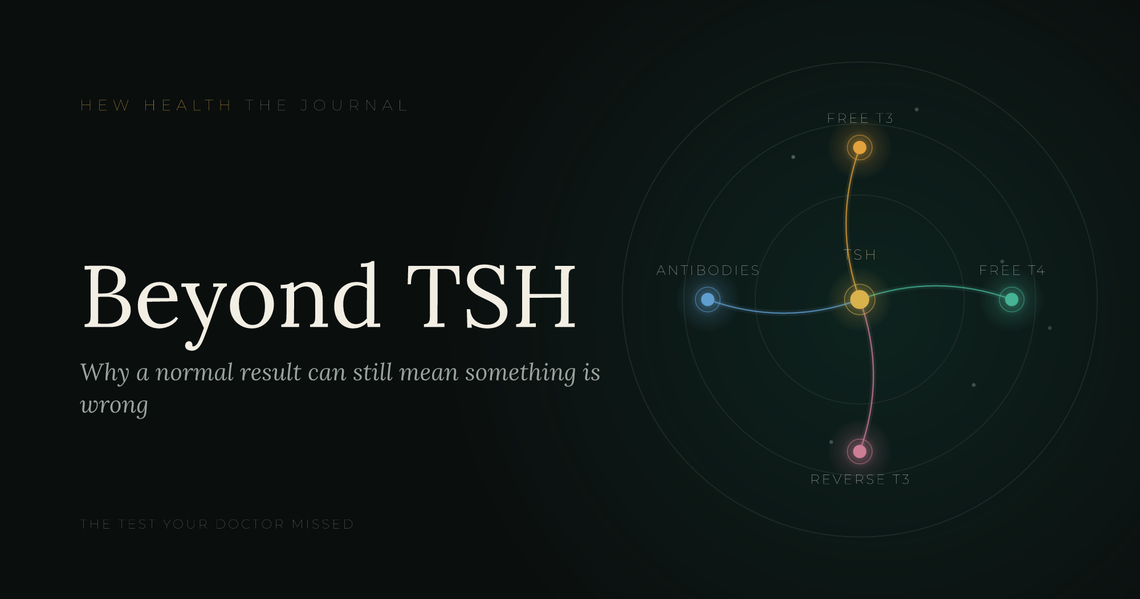
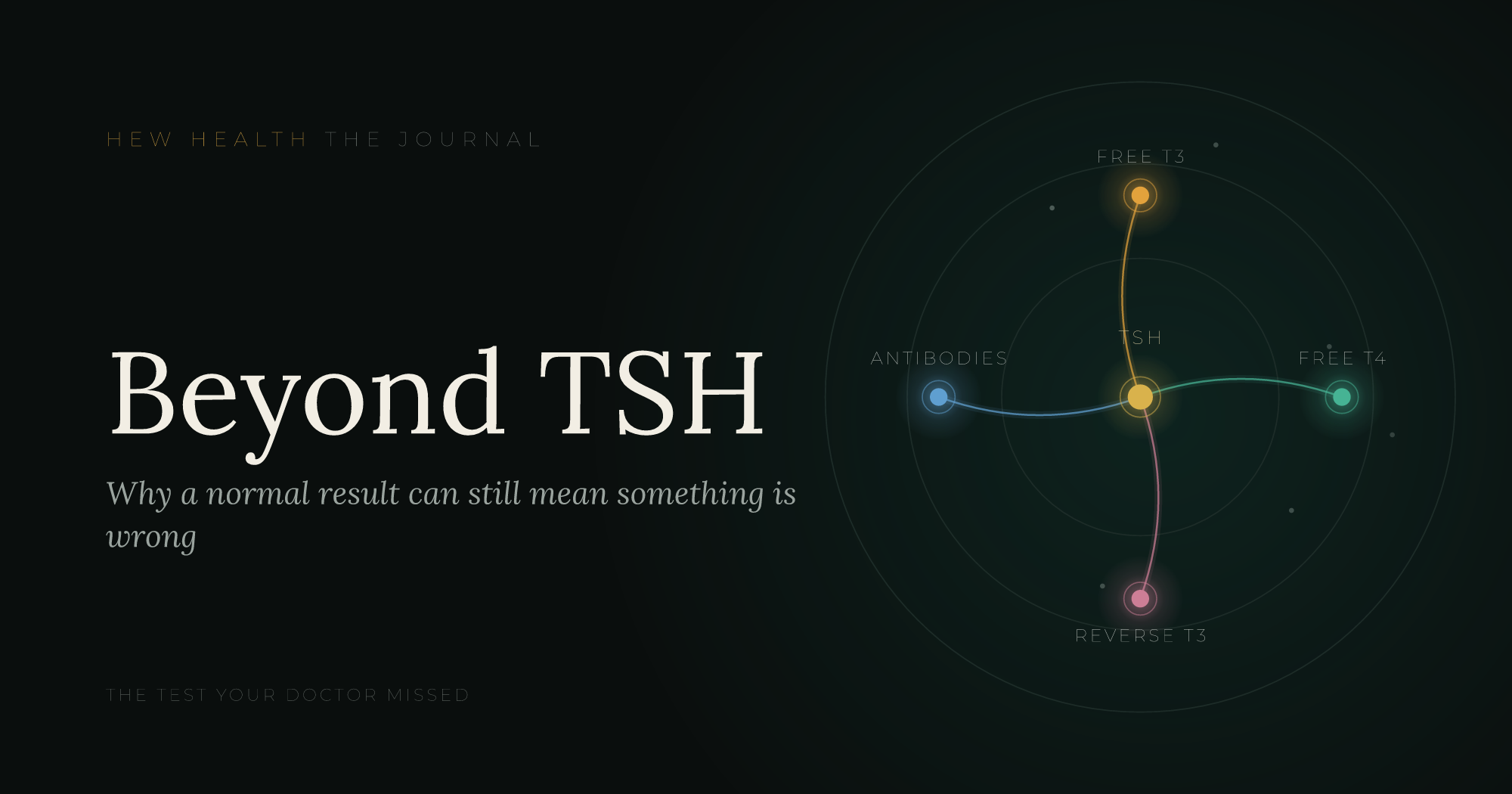
A more complete thyroid evaluation includes several markers that almost never appear on a standard wellness panel. Each one tells a different part of the story.
Free T4 and Free T3
T4 is the storage form of thyroid hormone. T3 is the active form, the one that actually binds to receptors in your cells and drives metabolism, temperature regulation, cognition, and energy production. Measuring the "free" (unbound) fraction matters because that is what your tissues can actually use. You can have adequate T4 and still be functionally hypothyroid if your body is not converting T4 into T3 efficiently. This conversion problem is genuinely common, and TSH will not catch it.
Reverse T3
When the body is under chronic stress, recovering from illness, dieting aggressively, or dealing with inflammation, it can shunt T4 into reverse T3 instead of active T3. Reverse T3 is biologically inert. It occupies receptors without activating them. Patients with elevated reverse T3 often describe a particular kind of exhaustion that no amount of sleep seems to fix. You will never see this on a basic panel.
Thyroid Antibodies (TPO and TgAb)
Hashimoto's thyroiditis is the most common cause of hypothyroidism in the United States, and it is an autoimmune condition. Antibodies can be elevated for years, sometimes a decade or more, before TSH starts to drift out of range. Catching antibody activity early changes the conversation entirely, because the intervention is no longer just about replacing hormone. It includes addressing the immune process itself.
Nutrient Cofactors
Thyroid hormone production and conversion depend on adequate iodine, selenium, zinc, iron (specifically ferritin), and vitamin D. A patient with ferritin of 22 and vitamin D of 18 will struggle to make and use thyroid hormone no matter what their TSH says. These are simple, cheap tests, and they get overlooked constantly.
Why This Matters for Hormone Optimization
Thyroid function does not exist in a vacuum. It sits in a tight feedback relationship with cortisol, insulin, estrogen, progesterone, and testosterone. Ignoring any one of these while optimizing the others tends to produce frustrating results.
A few examples we see regularly:
- A perimenopausal woman starting estrogen and progesterone whose fatigue does not improve, because her free T3 is hovering at the bottom of the range and no one checked it.
- A man on a testosterone protocol who builds muscle but cannot lose abdominal fat, because his reverse T3 is elevated from chronic poor sleep and undiagnosed sleep apnea.
- A woman in her early 40s told her thyroid is fine, who actually has TPO antibodies in the 400s and a slowly failing gland that will declare itself clinically in another two or three years.
When we approach hormone optimization properly, thyroid is part of the foundation, not an afterthought. Estrogen affects thyroid binding globulin. Testosterone influences metabolic rate. Cortisol patterns affect T4 to T3 conversion. You cannot optimize one axis while ignoring the others and expect the patient in front of you to feel well.
Symptoms That Warrant a Deeper Look
The classic teaching is that hypothyroid patients are cold, tired, constipated, and gaining weight, with dry skin and thinning hair. That description is accurate but incomplete. In our experience, the more revealing symptoms are often subtler:
- Outer third of the eyebrows thinning
- Morning resting heart rate consistently under 55 in a non-athlete
- Persistent puffiness around the eyes, particularly in the morning
- A basal body temperature that runs consistently below 97.8°F
- Slow recovery from workouts that used to feel routine
- Cognitive heaviness that worsens through the afternoon
- Heavy or irregular menstrual cycles in women under 50
None of these are diagnostic on their own. Together, in a patient with a "normal" TSH, they tell you to keep looking.
What Treatment Actually Looks Like
If a complete workup reveals a problem, treatment depends entirely on what we find. Some patients do well on levothyroxine alone, which is synthetic T4. Others need a combination of T4 and T3, either as separate prescriptions or as desiccated thyroid extract. Some patients with elevated antibodies and normal hormone levels benefit most from addressing the autoimmune drivers: gut health, vitamin D repletion, selenium, stress physiology, and in some cases low-dose naltrexone.
What we try to avoid is the reflexive prescription of a starting dose of levothyroxine based on TSH alone, followed by a repeat TSH in eight weeks and a dose adjustment, with nobody ever asking how the patient actually feels. That model has failed a lot of people. We can do better.
A Reasonable Next Step
If you suspect your thyroid is part of why you don't feel like yourself, ask for the full panel: TSH, free T4, free T3, reverse T3, TPO antibodies, thyroglobulin antibodies, ferritin, vitamin D, and a basic metabolic picture. Bring your symptoms in writing. Track your morning temperature for two weeks. Be specific about what has changed and when.
And if your current physician is not willing to look beyond TSH, find one who will. The information is there. It just has to be measured. To discuss your symptoms and what a complete evaluation might look like for you, request a consultation with our team.
Feeling well in your 40s and 50s is not a luxury, and it is not something you should have to negotiate for. The right workup is the first honest conversation.