# The Conversation We Don't Have Often Enough
*On the clinical questions that arrive late in the visit, and what changes when we ask them early.*
— The Editorial · Hew Health · Vol I, Issue 09
---
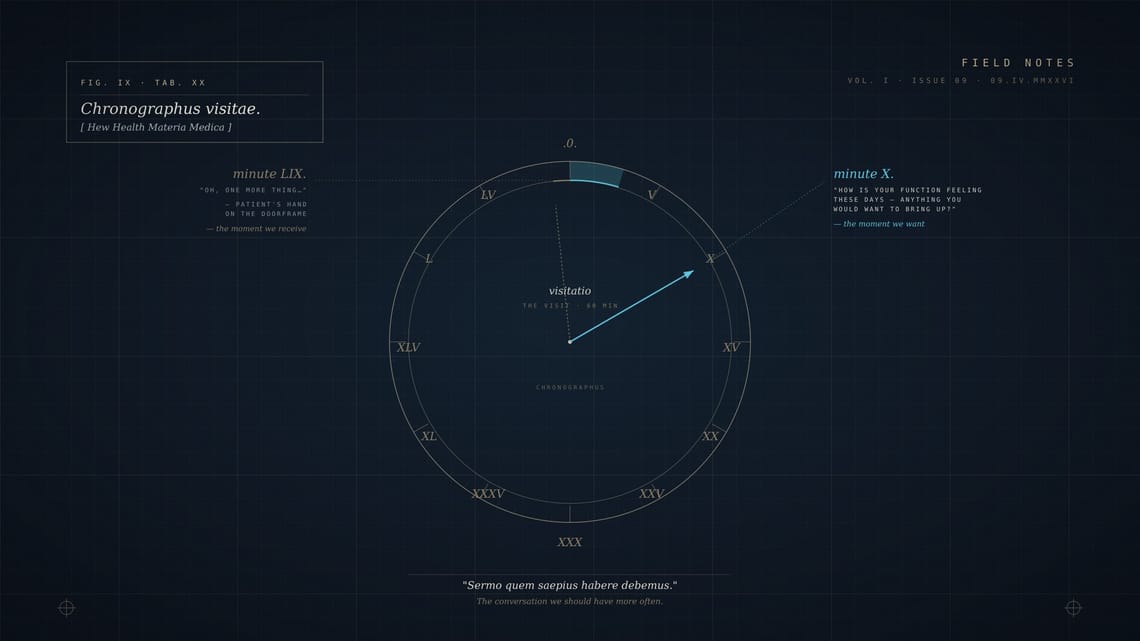
The conversation usually starts with "oh, one more thing." It is the patient's hand on the doorframe, the visit technically over, and a question they have been holding for forty-five minutes finally asked aloud. The question is some version of: *and… is there anything you can do about the other part of all this?*
The other part is almost always sexual function, libido, intimacy, or one of the half-dozen things that cluster under those headings. The patient has held the question because it feels like a separate conversation from the rest of medicine. It is not. It is the same conversation, and we have been training the practice to bring it up earlier so the patient does not have to.
## Why it arrives late
There are several reasons, all of which we see.
The patient is not sure it counts as medicine. They have been told, implicitly or explicitly, that what they are describing is a normal part of aging or a normal consequence of stress or simply not something a clinician will take seriously. They have read enough internet copy to suspect they are right to ask, but not enough to feel certain.
The patient is embarrassed. This one is the most common, and the most easily dispatched with a few minutes of professional matter-of-factness. Patients who arrive embarrassed almost always relax once the clinician treats the topic as ordinary clinical territory, which it is.
The patient does not know which symptom is the lead. They have been losing energy, sleeping worse, and noticing a change in their intimate life. They report the first two as the chief complaint because those feel safer to mention. The third was, in fact, the symptom they actually came in to discuss.
The patient is in a long relationship and does not want to imply blame. The question is partly about their own body and partly about a dynamic with another person. They are unsure where the medical question ends and the personal one begins.
## Why it should not arrive late
Sexual function is, in a fairly straightforward way, a system-level readout. The body in good optimization tends to have a working libido, working response, and a desire that is roughly congruent with the patient's own self-description. A patient whose optimization is otherwise excellent but whose sexual function is not is telling us something we want to hear early, not late.
That information is clinically useful. It often points us at a specific lab to look at, or a protocol element to reconsider, or an interaction between two protocols we should be thinking about. In some cases it points us at sleep, or stress, or a relationship dynamic where the medicine cannot do the work — but we cannot route the patient to the right answer without the question being asked.
When the question arrives in the last sixty seconds of a visit, we cannot do that routing well. The visit is over. We can schedule a follow-up, and we do, but the patient has now had to make the appointment specifically for this topic, which is itself a barrier.
When our clinicians bring it up at minute ten of a sixty-minute visit, the conversation can happen in the visit it belongs in.
## How we ask
We do not ambush. We do not lead with it. We bring it up the way we bring up any other system review, with the same professional cadence as asking about appetite, mood, or sleep. The question is some version of: *how is your sexual function feeling these days — anything you would want to bring up while we are here?*
Two things to note about the phrasing.
We ask about *function,* not just satisfaction. Satisfaction is a downstream metric that involves another person; function is something the patient can describe on their own. Starting with function makes the question more answerable.
We add the *while we are here* clause because it gives the patient an explicit invitation. The clause communicates that we have the time, that the visit can hold the question, that nothing else is going to be displaced by raising it.
The patient who has nothing to bring up says so, and we move on. The patient who has something to bring up has been given permission to bring it up in the place where it belongs.
## What we cover
The conversation, when it happens, covers a fairly predictable set of dimensions.
*What does the patient mean specifically* — desire, arousal, function, satisfaction, pain, frequency, or some combination. The terms get conflated in casual conversation; we untangle them.
*When did the change start, and what else changed around the same time* — medications, life events, sleep patterns, the rest of the optimization picture. Many changes in sexual function track other changes in the system that may be the actual driver.
*What has the patient already tried* — including supplements, off-label medications, devices, partner-assisted approaches, and the various subscription services that have proliferated. We are not judgmental about any of these. We want to know what is in the picture before we add to it.
*What outcome would the patient consider success* — and this question matters more than it sounds. A patient who would consider success "feeling like myself at thirty-five again" and a patient who would consider success "feeling like the partnership is back in working order" are pointing at different protocols. We need to know which.
## What we offer
The honest answer is: a lot of options, none of them complete on their own.
Hormone optimization done thoughtfully addresses much of this for many patients, both male and female. It is not a guarantee. Some patients see substantial improvement; some see modest improvement; some see none. The conversation about what to expect is part of the protocol design, not an afterthought.
Specific medications and devices have a role. Our clinicians will discuss them when relevant and prescribe what is appropriate. We do not lead with them when the underlying optimization picture has not yet been addressed.
Lifestyle factors — sleep, training, stress, alcohol, screen time, relationship dynamics — are part of every conversation. Sometimes they are the conversation. Patients who arrive expecting a pill and leave with a conversation about sleep architecture are sometimes the patients who improve the most.
Referral, when needed, is offered openly. There are partners on this — pelvic floor specialists, couples therapists, urologists with specific subspecialty training. We work with several. We refer when the right answer is outside our practice.
## The point of the dispatch
We are not writing this because the topic is unusual. We are writing it because, in our experience, the topic is treated as unusual when it should be treated as ordinary. A clinical practice that treats intimacy as ordinary, that asks the question without ceremony, that makes the conversation easy to have — that practice can do better work for its patients than one that waits for "oh, one more thing."
We bring it up at minute ten. That is the entire methodology. Everything else follows.
⁂
---
**Tags:** Intimate Wellness · Hormone Optimization · Patient Care · Clinical Practice**Author:** The Editorial**Category:** Patient Care**Read time:** ~8 min
---
*Field Notes is the editorial blog of Hew Health, a concierge medicine practice publishing from Destin and Orlando. Read across forty-seven states.*
The Conversation We Don't Have Often Enough
# The Conversation We Don't Have Often Enough *On the clinical questions that arrive late in the visit, and what changes when we ask them early.* — The Editorial · Hew Health · Vol I, Issue 09 --- The conversation usually starts with "oh, one more thing." It is the
Field Notes · Vol. I
19.06.2026