How Cortisol and Sex Hormones Interact, and Why Balance Matters for Energy and Focus
Most patients who walk into our office complaining of brain fog and fatigue have already had their thyroid checked. Some have had a testosterone level drawn, or an estradiol. What almost none of them have had is a real conversation about how their stress physiology is talking to their sex hormones, and why that conversation often decides whether they feel sharp at 3 p.m. or reach for a third coffee.
Cortisol and the sex hormones (testosterone, estrogen, progesterone, DHEA) share biochemical machinery, share regulatory pathways in the brain, and share the same 24-hour clock. When one is chronically off, the others rarely stay quiet. Understanding that relationship is one of the more useful things you can do for your energy, your focus, and frankly your patience with the people around you.
The Shared Assembly Line
Cortisol and the sex hormones are all steroid hormones, meaning they start life as cholesterol and get modified, step by step, by a series of enzymes. Pregnenolone sits near the top of that pathway. From there, the body can shunt raw material toward the cortisol arm or toward the DHEA and sex hormone arm. The idea that stress "steals" pregnenolone from sex hormone production (the so-called pregnenolone steal) has been oversimplified in the wellness world, because each tissue regulates its own steroid synthesis locally rather than drawing from a single shared pool. Still, the underlying point holds: chronic activation of the stress axis reshapes the entire steroid environment, and it does so in ways you can feel.
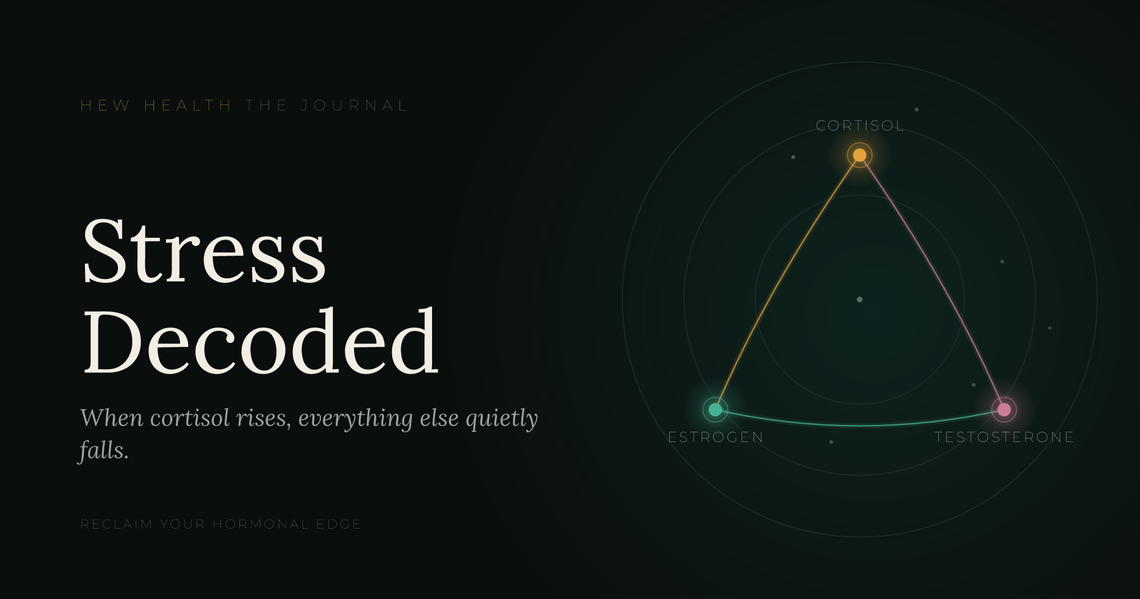
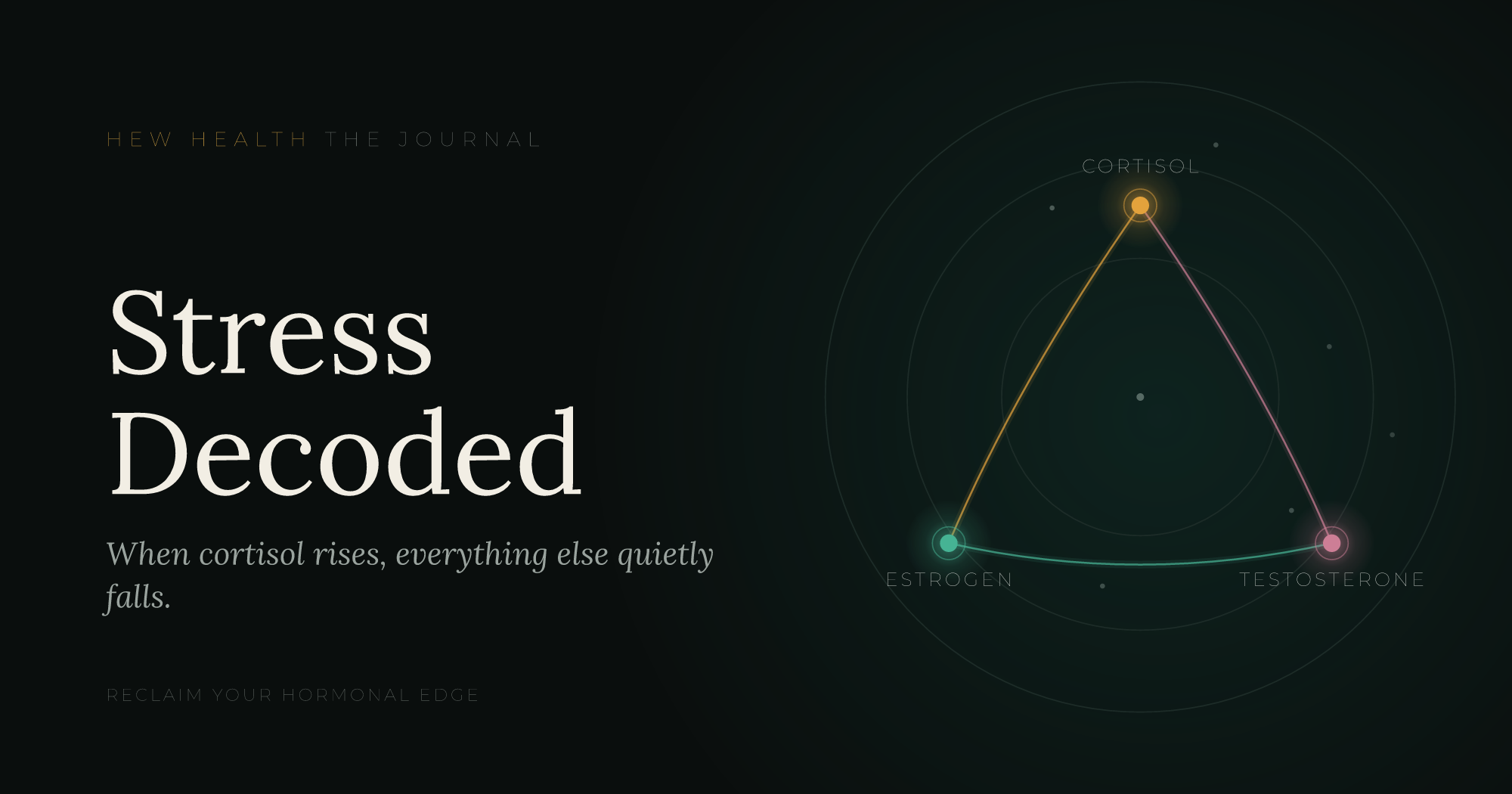
What actually happens in a chronically stressed body is more interesting. The hypothalamic-pituitary-adrenal (HPA) axis, which governs cortisol, cross-talks with the hypothalamic-pituitary-gonadal (HPG) axis, which governs testosterone and estrogen. Elevated CRH and cortisol suppress gonadotropin-releasing hormone at the hypothalamus. Less GnRH means less LH and FSH from the pituitary. Less LH means the testes make less testosterone and the ovaries produce less estradiol and progesterone in a coordinated cycle. This is the mechanism, and it is well described.
What This Feels Like in Real Life
In our practice, we often see a pattern in high-functioning adults in their forties and fifties. Sleep gets shorter. Workouts feel heavier. The afternoon dip becomes a cliff. Libido quietly leaves the room. Words that used to arrive on time now show up a beat late in meetings. Labs might show a testosterone in the "low-normal" range, an unremarkable estradiol, a TSH that looks fine. Everyone shrugs.
The missing piece is usually cortisol rhythm. Not a single random cortisol value, which is nearly useless outside of specific endocrine workups, but the shape of the curve across the day. A healthy pattern peaks about 30 to 45 minutes after waking and tapers steadily into the evening. What we frequently find in tired, foggy patients is a blunted morning peak, a mid-afternoon slump, and a second wind at 10 p.m. that wrecks sleep onset. That flattened curve is often accompanied by suppressed free testosterone, lower DHEA-S, and, in perimenopausal women, an erratic progesterone.
Why Focus Suffers Specifically
Cortisol is not the villain here. You need it. A brisk morning cortisol pulse is part of what wakes your brain up, mobilizes glucose, and gives you the executive function to get through a demanding morning. The problem is timing and amplitude. Chronically elevated evening cortisol fragments deep sleep, which is when memory consolidation and glymphatic clearance happen. Blunted morning cortisol leaves you underpowered when you need to think hardest.
Testosterone and estradiol both act directly on the brain. Estradiol supports serotonergic and dopaminergic tone, cerebral blood flow, and verbal memory. Testosterone contributes to motivation, spatial cognition, and mood stability in both men and women. Progesterone's metabolite allopregnanolone is a positive modulator of GABA receptors, which is a large part of why adequate progesterone tends to correlate with better sleep in women. When the HPA axis is chronically running the show, all of these signals get quieter. You feel it as fog, flatness, and a shorter fuse.
What We Actually Measure
A useful workup for someone with these symptoms goes beyond a single morning testosterone. In our practice we typically look at:
- Total and free testosterone, SHBG, estradiol (sensitive assay for men and postmenopausal women), and DHEA-S
- Progesterone timed appropriately in cycling women, or baseline in postmenopausal patients
- Diurnal cortisol, usually four points across the day via salivary or dried urine testing, rather than a one-off serum draw
- Thyroid panel including free T3, free T4, reverse T3, and antibodies
- Fasting insulin, HbA1c, ferritin, vitamin D, and a basic metabolic and lipid panel
The reason to look broadly is that these systems are entangled. Insulin resistance suppresses SHBG and shifts sex hormone availability. Low ferritin blunts thyroid conversion. Poor sleep drives cortisol dysregulation, which suppresses gonadal output, which worsens sleep. You want to see the whole picture before you start pulling levers.
What Actually Helps
The interventions that move these numbers are not glamorous, but they work.
Sleep architecture first. Before we consider hormone optimization protocols, we address sleep. Consistent wake time, morning daylight within the first hour, a hard cap on alcohol (which fragments REM and elevates nocturnal cortisol), and a genuine wind-down window. If someone is snoring or waking unrefreshed, we look hard at sleep apnea, which by itself will drive down morning testosterone in men.
Training that matches your physiology. Chronic high-volume cardio in an already-stressed adult often makes things worse. Two to three strength sessions per week, walking, and one harder conditioning session tends to be far more restorative than daily depletion.
Protein, light, and caffeine timing. Thirty to forty grams of protein at breakfast stabilizes energy. Ten minutes of outdoor light in the morning anchors the cortisol rhythm. Cutting caffeine after noon protects the evening downslope.
Hormone optimization when indicated. When labs and symptoms both support it, thoughtful hormone optimization (testosterone in men, and estradiol with progesterone in perimenopausal and postmenopausal women) can be genuinely transformative for energy and cognition. This is done conservatively, with baseline and follow-up labs, and always in the context of the whole clinical picture. DHEA supplementation is sometimes appropriate when DHEA-S is measurably low, particularly in women.
Addressing the stress input. No amount of hormone optimization overrides a nervous system that never gets to stand down. Structured recovery (breathwork, therapy, actual time off, boundaries around work communication) is not a wellness luxury. It is part of the treatment.
The Case for Looking at Both Axes Together
The mistake we see most often is treating one hormone in isolation. A man is put on testosterone alone while his cortisol curve stays inverted and his sleep is still terrible, and he wonders why he does not feel better. A woman is offered an SSRI for perimenopausal irritability while her progesterone is nearly undetectable and her cortisol is spiking at 11 p.m. These are incomplete pictures.
The endocrine system does not care about our clinical categories. It responds to inputs, and the inputs include your sleep, your training, your food, your relationships, and the quality of your recovery. Cortisol and sex hormones are two arms of the same organism trying to keep you upright. When you look at them together, the interventions get more precise and the results get more durable.
If you have been chasing energy and focus with more caffeine, more discipline, and more supplements without much to show for it, a proper evaluation of both axes is often the missing step. To discuss your situation with our team, request a consultation and we will take it from there.
Related from Hew Health