# The 47-State Question
*How telemedicine actually works inside a concierge hormone optimization practice.*
— The Editorial · Hew Health · Vol I, Issue 07
---
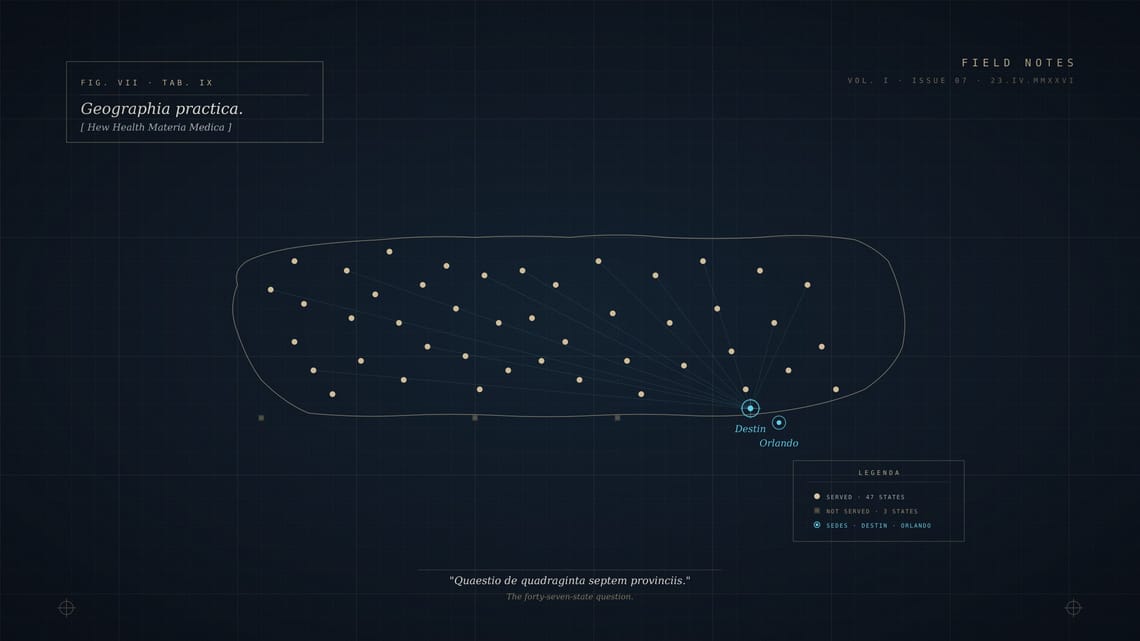
The map on our homepage says forty-seven states. It is not a marketing flourish — we mean it literally, and the number gets asked about often enough that it deserves its own dispatch. What does it actually mean to operate a clinical practice across forty-seven separate state licensing regimes, three time zones, two physical locations, and one continuous bloodwork chain?
Mostly it means a lot of operations work that the patient never sees. Some of it is interesting enough to share.
## Licensing math
Medicine is licensed at the state level. A clinician licensed in Florida can practice on a patient in Florida. They cannot practice on a patient who happens to be in Georgia at the moment of the visit, even if the patient lives in Florida the other fifty weeks of the year.
The traditional path around this — and it is a path, not a workaround — is for the clinician to hold licenses in every state where their patients live. The licenses are not interchangeable. Each is a separate application, a separate fee, separate continuing education requirements, separate renewal cycles. The math gets large quickly.
The practical implication: a multi-state telemedicine practice is, behind the scenes, a portfolio of licenses being actively maintained. We track them on a spreadsheet that we look at more than we would like to.
## The state we are not in
Astute readers will have noticed that forty-seven states is not fifty. Three states currently require structures we have chosen not to build, for reasons that vary by state. We will not name them here because the list shifts as regulations change — what we cannot serve today we may be able to serve next quarter, and vice versa. Patients who ask are told plainly.
If a current patient moves to one of the three, we have honest conversations about what we can and cannot continue to do for them, and we help them transition if needed.
## Time zones, and why Central time wins
The practice operates on Central time. This is not because we are in Central — Destin is, but Orlando is Eastern, and a substantial number of our patients are in Mountain or Pacific. We chose Central because, mathematically, it sits closest to the center of our patient base. A Pacific patient and an Eastern patient looking for a midday appointment can both find one without one of them booking at 6:00 AM.
Every communication that includes a time references Central time explicitly. CT, CST, or CDT depending on the season. The patient does not have to do the math; we do.
## The bloodwork chain
This is the part of the operation that gets the least credit and is the most important. Optimization medicine, when done well, depends on regular, accurate, repeatable bloodwork. A patient in Boise and a patient in Boca need the same level of confidence in their numbers. We work with three lab paths.
**Concierge collection** is our flagship — a phlebotomist arrives at the patient's home or office, draws on a schedule we coordinate, and the sample is processed through our partner lab. This is available to our Destin patients and to some patients within driving range. The advantage is total control over the draw conditions: fasted, hydrated, at the right time of day, in the right week of the cycle if relevant.
**Network phlebotomy** uses a national network of draw stations. For a patient in a city without our concierge collection, we route the draw to a station we have vetted and coordinate the kit. The patient walks in, gets drawn, walks out. Results come back to us, not to the patient's local clinician.
**Standing orders at LabCorp or Quest** is the fallback. It is functional, but the loss of control over collection conditions means we are interpreting the results with more variance than the other two paths. For a patient who prefers this — convenience often wins for working professionals — we accept the trade and read the labs with that variance in mind.
The lab path is a clinical decision, not a logistics one. We assign it deliberately based on the patient's protocol and what we need to see.
## Medications, shipped
Most of our protocols involve medications that are compounded or prescribed and shipped from a partner pharmacy. We do not stock medications in either physical office. The pharmacy partner ships directly to the patient. We track delivery, confirm receipt, and time refill cadence to the protocol.
The shipping logistics are mostly invisible until they are not — a missed refill window can cost a patient a week of progress on a protocol that runs in months. The reminder system that keeps it from happening is one of the operational pieces we have spent the most time getting right.
## The two physical locations
Destin is our base of operations. Orlando is where we see patients in person who prefer in-person and live close enough for it to be reasonable. Most of the work, for most of our patients, happens by telemedicine — but we hold to the principle that a patient who wants to look us in the eye should be able to.
The two offices are not redundant. They are complementary. The physical locations matter for the initial workup, for procedural visits (IV therapy, EBOO, certain regenerative work), and for the patient who simply wants to know there is a room they could walk into.
## The boring version
Most of this is boring. Most of it is exactly the kind of operational discipline that a small practice has to build from scratch because no one packaged it. We are not in the business of making operations look exciting. We are in the business of making them so reliable that the patient never has to think about them.
That is the actual answer to the 47-state question. The number is the easy part. The infrastructure that lets the number mean something is the work.
⁂
---
**Tags:** Telemedicine · Operations · Concierge · Field Notes**Author:** The Editorial**Category:** Field**Read time:** ~7 min
---
*Field Notes is the editorial blog of Hew Health, a concierge medicine practice publishing from Destin and Orlando. Read across forty-seven states.*
The 47-State Question
# The 47-State Question *How telemedicine actually works inside a concierge hormone optimization practice.* — The Editorial · Hew Health · Vol I, Issue 07 --- The map on our homepage says forty-seven states. It is not a marketing flourish — we mean it literally, and the number gets asked about often enough that it
Field Notes · Vol. I
10.06.2026