Testosterone, Estrogen, and Cortisol: The Three Hormones Behind Your Energy, Focus, and Body Composition
Most patients who walk into our practice in their forties and fifties describe some version of the same complaint. They are sleeping less well, thinking less sharply, and carrying weight in places they never used to. They have tried the obvious fixes. More cardio. Fewer carbs. An extra hour in bed on Sunday. Nothing quite works the way it used to.
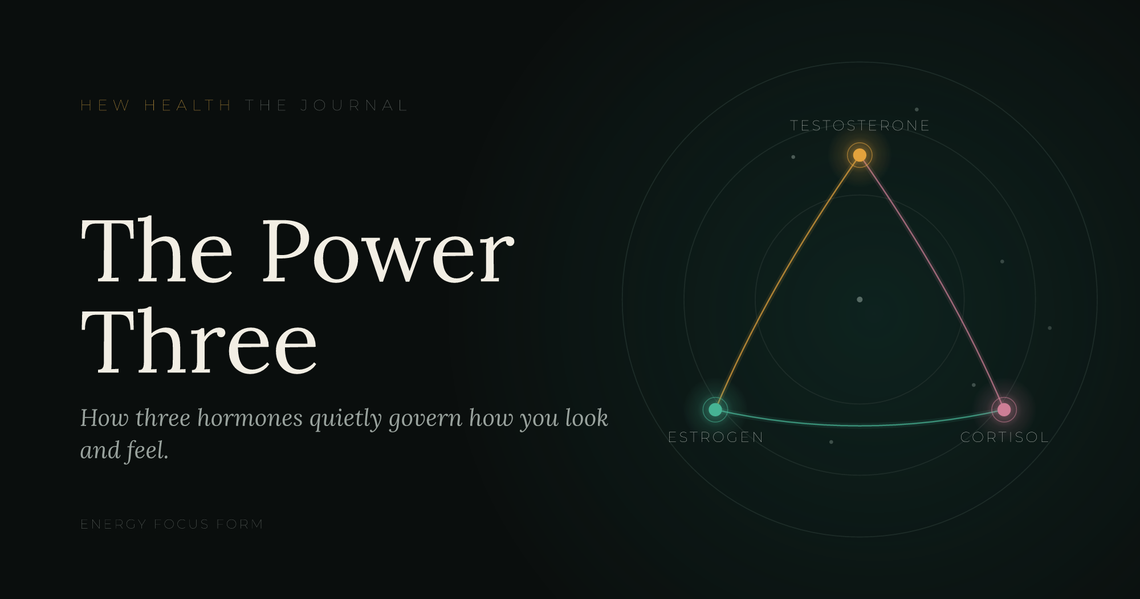
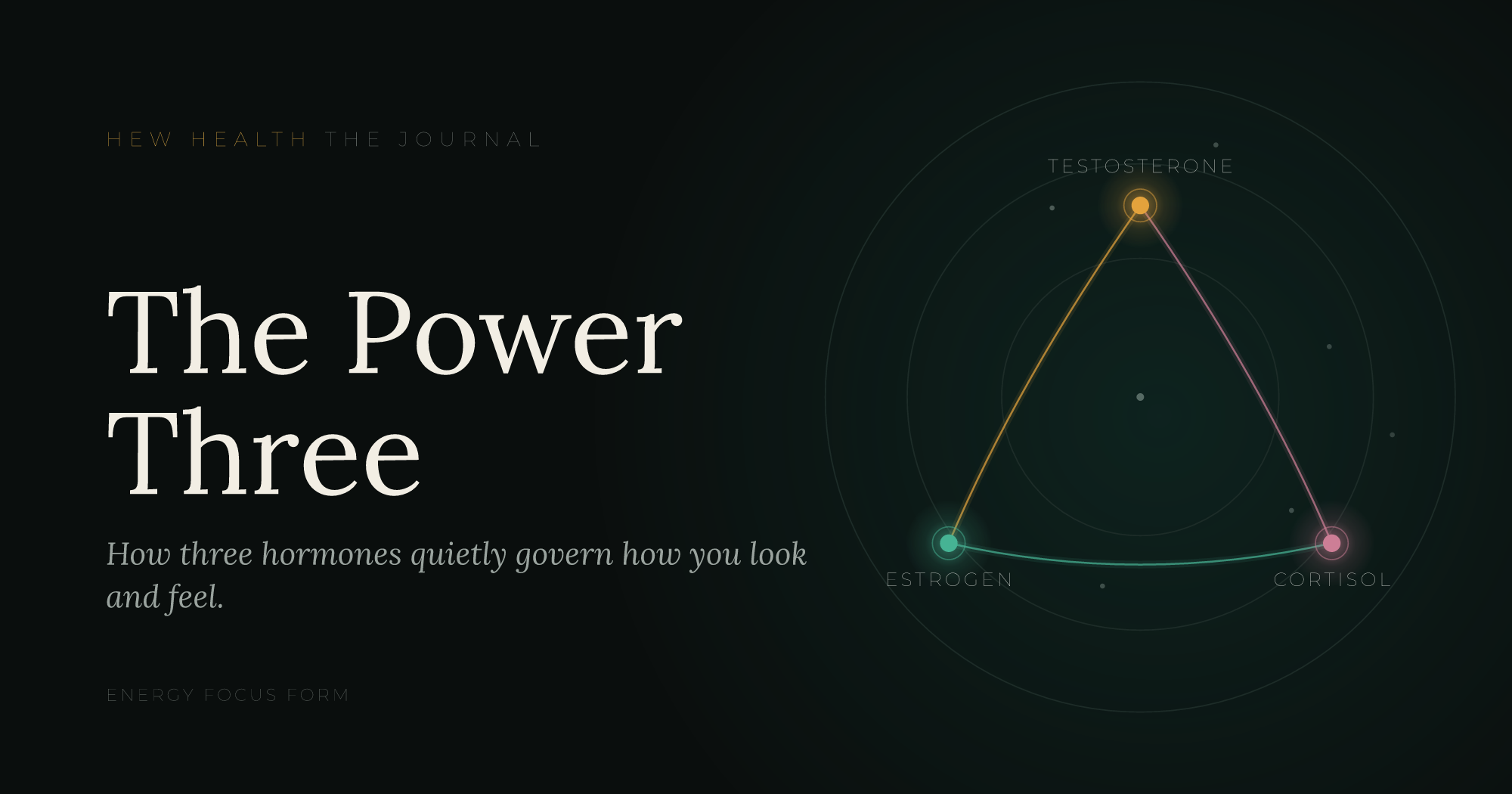
The reason, more often than not, sits inside the interplay of three hormones: testosterone, estrogen, and cortisol. Each does specific work in the body. Where things get interesting, and where symptoms tend to originate, is in how they influence each other. I want to walk you through what we actually see in clinic, what the labs mean, and how we think about hormone optimization in adults between roughly 35 and 58.
Testosterone: More Than a Male Hormone
Testosterone gets talked about as if it belongs only to men. It does not. Women produce it in the ovaries and adrenal glands, and it drives libido, mood stability, muscle tone, and the density of bone that keeps you upright at 75. In men, total testosterone tends to peak in the late teens and early twenties, then decline roughly 1 to 2 percent per year after age 30. Free testosterone (the fraction not bound to sex hormone binding globulin) often falls faster, especially when SHBG rises with age, alcohol use, or thyroid shifts.
The symptoms are rarely dramatic. Patients describe a flatness. Workouts that used to build muscle now just cause soreness. Motivation dips. Erections become less reliable in men, and women in perimenopause often report a loss of desire that predates their hot flashes by years. Body composition changes: visceral fat rises, lean mass falls, and the scale can stay identical while the mirror tells a different story.
When we evaluate testosterone, we do not chase a number. We look at total and free testosterone, SHBG, estradiol, LH, FSH, and correlate those against what you are actually experiencing. A 45-year-old man with a total testosterone of 380 ng/dL and crushing fatigue is a very different patient from a 45-year-old at 380 who feels fine.
Estrogen: The Hormone That Does Almost Everything
Estradiol, the dominant form of estrogen in reproductive-age adults, does far more than regulate menstrual cycles. It maintains the lining of blood vessels, supports serotonin and dopamine signaling in the brain, keeps skin and vaginal tissue elastic, protects bone, and influences insulin sensitivity. Men make estrogen too, converting a portion of their testosterone via the aromatase enzyme. Too little estrogen in men is as problematic as too much: joint pain, low libido, and poor lipid profiles are the usual signs.
For women, the perimenopausal transition typically begins in the early to mid-forties, sometimes earlier. It is not a smooth decline. Estradiol swings wildly, often reaching higher peaks than in the reproductive years before dropping. Those swings are what produce the classic symptoms: night sweats, disrupted sleep, brain fog, anxiety that feels chemical rather than situational, and a stubborn shift of fat toward the abdomen. Progesterone falls earlier and more steadily, which is why sleep quality often deteriorates first.
By the time menstrual periods stop entirely (menopause, defined as 12 consecutive months without a cycle), estradiol has usually settled at a low, stable level. Symptoms may improve for some women and worsen for others. Bone loss accelerates. Cardiovascular risk begins to catch up to that of male peers.
Cortisol: The Hormone That Rewrites the Rules
Cortisol is the reason the other two hormones matter less than you think in isolation. Produced by the adrenal glands under direction from the pituitary, cortisol follows a diurnal rhythm: high in the morning to get you out of bed, tapering through the day, low at night to let you sleep. Under acute stress it spikes, mobilizes glucose, sharpens attention, and then returns to baseline.
The problem in modern life is that the stress rarely stops. Poor sleep, alcohol in the evenings, chronic work pressure, inflammatory diets, and overtraining all keep cortisol elevated when it should be falling. Chronically high cortisol does several things that undo the work of testosterone and estrogen:
- It raises SHBG, which lowers free testosterone and free estradiol.
- It promotes visceral fat deposition, particularly around the abdomen.
- It reduces insulin sensitivity, making the same meal more likely to be stored as fat.
- It suppresses the pituitary signals (LH and FSH) that tell the gonads to produce sex hormones.
- It fragments sleep architecture, reducing the deep sleep phases when growth hormone and testosterone are produced.
You can be doing everything right with your sex hormones and still feel terrible if cortisol is not managed. In our practice, we test cortisol both with a morning serum draw and, when the clinical picture warrants, a four-point salivary panel that maps the daily curve.
How the Three Interact in Real Patients
Consider a 48-year-old woman who comes in exhausted, gaining weight around her middle, waking at 3 a.m. with her heart pounding. Her estradiol is fluctuating. Her progesterone is low. Her morning cortisol is high, and her nighttime cortisol has not fallen the way it should. Giving her estradiol alone will help her hot flashes but may not fix her sleep. Addressing cortisol through sleep hygiene, alcohol reduction, and sometimes short-term adaptogenic support often unlocks the rest of the picture.
Or take a 52-year-old man with a total testosterone of 320, borderline low, complaining of fatigue and softening muscle tone. His cortisol is elevated. His sleep apnea is untreated. Starting testosterone before addressing the apnea and the cortisol will produce a mediocre result and may worsen his blood pressure. Sequencing matters.
What Meaningful Evaluation Looks Like
A useful hormone workup in this age range typically includes total and free testosterone, estradiol, progesterone (in women), SHBG, DHEA-S, morning cortisol, TSH with free T3 and T4, a metabolic panel, fasting insulin, hemoglobin A1c, and a lipid panel. In men we add PSA and a hematocrit before considering optimization. In women, thyroid antibodies and a full iron panel often reveal things that mimic hormonal symptoms.
Numbers alone are not a diagnosis. Reference ranges are wide, and "normal" for a lab is not the same as optimal for a person. We spend more time on history than on results, and we retest before making changes.
What Actually Moves the Needle
Before or alongside any prescription protocol, the foundations do heavy lifting. Seven to nine hours of sleep in a cool, dark room. Resistance training two to four times per week (this raises testosterone and improves insulin sensitivity more reliably than any supplement). Protein intake around 0.7 to 1 gram per pound of goal body weight. Alcohol capped at a level your liver can actually process, which for most people is less than they think. Daylight in the morning and dim light in the evening to anchor cortisol rhythm.
When hormone optimization is appropriate, we tailor it. That may mean transdermal estradiol with cyclic or continuous progesterone for a perimenopausal woman, testosterone cypionate or a topical preparation for a man with confirmed deficiency, or a combination approach for a woman whose libido and energy are the primary concern. Doses are conservative. Follow-up labs are non-negotiable.
Where to Start
If you recognize yourself in any of this, the useful next step is a proper evaluation rather than another supplement bottle. Hormones behave as a system. Treating one in isolation, without understanding how the others are moving, tends to disappoint. If you would like to have that conversation with a physician who will actually look at the whole picture, request a consultation with our team and we will take it from there.
Related from Hew Health