# Reading Your Own Bloodwork
*A short primer for patients who want to understand what they are looking at before the visit, rather than after.*
— The Editorial · Hew Health · Vol I, Issue 06
---
A patient comes in with a folder. The folder has six months of labs in it — quarterly comprehensive panels, all carefully filed, all printed front-and-back. He has highlighted the values that are flagged red or yellow by the lab's reference range. He wants to know what to do about each of them.
We open the folder, set it aside, and ask him how he has been sleeping.
This is not us being clever. It is us trying to get the conversation back into the order it should be in. The labs are a tool. The patient is the patient. We treat the patient with the labs as one input — not the other way around.
But the question that prompted this dispatch is a real one. Patients increasingly want to understand their own bloodwork. They have access to it through patient portals. They sometimes have access to it months before their next visit. They would like to know what to make of it on their own.
We are happy to teach them. Here is the short version.
## What the reference range is and is not
Every lab value comes with a reference range. The reference range is not "normal" in any clinical sense. It is "statistically common in the population the lab tests." If you are testing a lot of sick people, the reference range will include a lot of sick values. If you are testing a lot of older people, the reference range will skew older. Most reference ranges in commercial labs are calibrated to a general population that is, on average, not very healthy.
This matters because a value that falls comfortably inside the reference range can still be a value worth moving. A testosterone level of 320 ng/dL in a 38-year-old man is "in range." It is also a level our clinicians would likely want to see higher, assuming the rest of the picture supports it. Vice versa: a TSH of 4.1 is technically in range. We would want to know more before declaring the thyroid fine.
## What flags actually mean
The red and yellow markers on a lab printout are useful, but they are not a treatment plan. They are a flag. They mean "this value is outside the reference range." They do not mean "this is clinically significant." They do not mean "we need to intervene." They mean we should look.
Some flagged values are noise. A creatinine slightly high in a patient who deadlifted heavily two days before the draw is not kidney injury — it is muscle. A glucose slightly high in a patient who drank a coffee with sugar on the way to the draw is not diabetes — it is a coffee. The first job, when a value flags, is to ask what was going on around the draw.
## The values worth understanding well
For our practice — hormone optimization, peptide therapy, weight, regenerative — these are the values worth being able to read.
**Comprehensive metabolic panel.** Sodium, potassium, glucose, creatinine, BUN, liver enzymes, calcium. These are the canary in the mine. If something is dramatically wrong systemically, this panel tells us first. Most of the time, in a healthy adult, they should be unremarkable.
**Complete blood count.** Red and white cell lines, platelets. Most relevant in our practice for tracking how the body is responding to specific protocols (some peptides shift counts; some hormone optimization will modestly shift hemoglobin). Patterns matter more than single values.
**Lipid panel.** Total cholesterol, LDL, HDL, triglycerides. Worth understanding the ratios as well as the absolute values. The current literature has moved beyond "lower LDL is always better." Patterns and particle size matter. We do not interpret a lipid panel without context.
**Comprehensive hormone panels.** Whatever applies to the patient's protocol — total and free testosterone, estradiol, progesterone, DHEA-S, cortisol (timed appropriately), thyroid (TSH, free T3, free T4, antibodies). Reading these is a skill. We are happy to teach it.
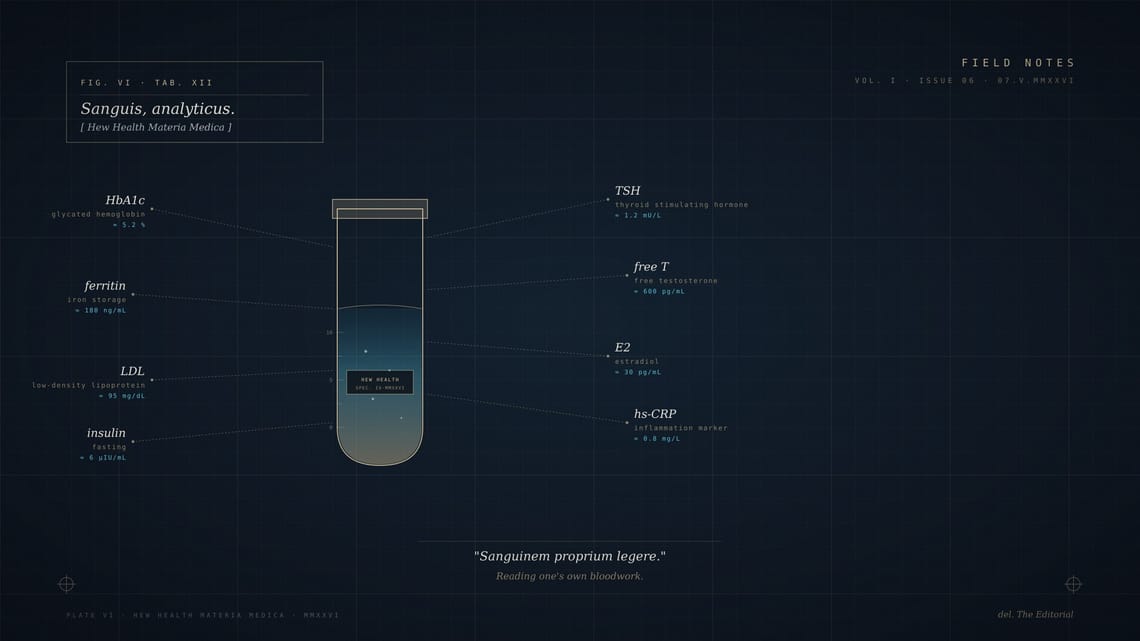
**Inflammatory markers.** hs-CRP, fibrinogen, ferritin (which is both an iron marker and an inflammation marker, which is part of what makes it useful). These give us a sense of whether the system is running hot.
**Metabolic markers.** Fasting insulin, HbA1c, fasting glucose, sometimes a fructosamine. Together these tell us about glucose handling over different time windows.
## The patient question, restated
What patients are usually asking when they ask us to "read their labs" is some version of: *am I OK, or do I need to be worried?*
The honest answer, ninety percent of the time, is: you are OK; you are also someone whose system has room to be optimized. Those are two different statements, and a lot of patient anxiety lives in the gap between them.
The conversation we want to have is not *what is wrong with this value*. It is *what is this value telling us about the system, and what would we change to move it where we want it.*
That conversation does not happen well in fifteen minutes. It is one of the reasons our visits are longer than fifteen minutes.
## What to do with the folder
Bring it. We will look at it together. Highlighting the flagged values was not the wrong move — it is a reasonable way to organize what a patient has been worrying about. We will work through them in order, and we will set most of them aside.
The ones that remain are the ones we will work on, together, between now and the next draw.
⁂
---
**Tags:** Patient Education · Bloodwork · Lab Interpretation · Optimization**Author:** The Editorial**Category:** Patient Education**Read time:** ~6 min
---
*Field Notes is the editorial blog of Hew Health, a concierge medicine practice publishing from Destin and Orlando. Read across forty-seven states.*
Reading Your Own Bloodwork
# Reading Your Own Bloodwork *A short primer for patients who want to understand what they are looking at before the visit, rather than after.* — The Editorial · Hew Health · Vol I, Issue 06 --- A patient comes in with a folder. The folder has six months of labs in it — quarterly
Field Notes · Vol. I
15.06.2026