Cortisol, Testosterone, and Estrogen: Understanding the Hormone Trio That Drives High Performance
Most of the high-functioning patients I see in our practice don't walk in complaining about hormones. They complain about sleep that doesn't restore them, workouts that used to build muscle and now just hurt, a fuse that's shorter than it was at 38, and a strange flatness where ambition used to live. When we run the labs, the story almost always involves three hormones working in concert or, more often, working at cross purposes: cortisol, testosterone, and estrogen.
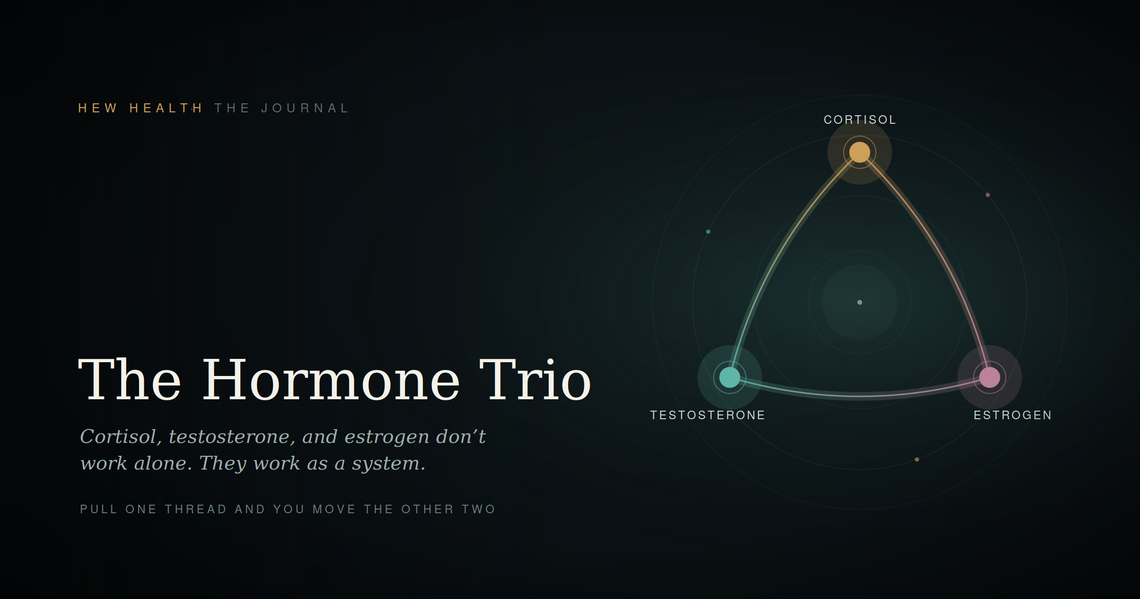
These three are not independent dials. They are a system. Understanding how they speak to each other (and where they break down) is one of the more useful lenses we have for thinking about performance in the second half of adult life.
Cortisol: The Tempo Setter
Cortisol gets a bad reputation it doesn't fully deserve. You need a healthy cortisol pulse to wake up, to mobilize glucose, to handle the inevitable stressors of an interesting life. The problem is rarely cortisol itself. The problem is the pattern.
A healthy curve peaks within 30 to 45 minutes of waking, drifts down through the day, and bottoms out around midnight so that growth hormone and melatonin can do their nighttime work. What I see in executives, surgeons, founders, and trial attorneys is a curve that has lost its shape. Morning cortisol is blunted, so they need three coffees to start. Evening cortisol is elevated, so they cannot fall asleep without alcohol or edibles. The 3 a.m. wake-up, eyes wide, mind racing, is almost a signature finding.
Chronically elevated cortisol does several things that matter for the other two hormones in this article. It suppresses gonadotropin-releasing hormone at the hypothalamus, which means less signal to produce testosterone. It upregulates aromatase activity in adipose tissue, shifting testosterone toward estradiol. It blunts thyroid conversion. It promotes visceral fat deposition, which then produces more inflammatory signaling, which then drives more cortisol. The loop is self-reinforcing, and you can stay inside it for years before something cracks.
Testosterone: More Than a Men's Hormone
In men, total testosterone in the 300s with free testosterone at the bottom of the range has become almost ordinary at age 50. Whether it should be considered normal is a separate question. Symptoms tend to track free testosterone, sex hormone-binding globulin, and the ratio of estradiol to testosterone more than they track the total number on the lab slip.
What patients describe is recognizable across hundreds of intakes: morning erections gone, recovery from training extended from one day to three or four, motivation that feels like it requires a running start, a body composition that drifts toward central adiposity even when caloric intake hasn't changed. Mood symptoms often look like mild depression but don't respond well to SSRIs because the underlying issue is endocrine, not serotonergic.
Women produce roughly a tenth of the testosterone men do, and they need it just as much. Female patients in their 40s with crashing libido, loss of muscle tone, and a curious cognitive haze frequently have free testosterone that is functionally undetectable. This conversation rarely happens in standard gynecology visits, which is a gap worth closing.
Estrogen: The Hormone Both Sexes Misunderstand
Men need estradiol. Too little, and you get joint pain, poor lipid profiles, low libido (yes, despite adequate testosterone), and accelerated bone loss. Too much, and you get water retention, emotional lability, breast tenderness, and a body composition that won't budge. The sweet spot for most men is narrower than the lab reference range suggests, and getting there often requires careful management of aromatization rather than aggressive blockade.
For women, the perimenopausal transition is where this whole article comes alive. Estradiol does not decline in a straight line. It swings, sometimes wildly, for years before it falls. Those swings drive the hot flashes, the sleep disruption, the sudden onset anxiety in women who have never been anxious, and the migraines that show up in the late 40s. Progesterone usually drops first, which removes a calming influence and leaves estrogen relatively unopposed. By the time conventional labs show a menopausal pattern, the patient has often been suffering for three to five years.
How the Trio Actually Interacts
This is where the clinical picture gets interesting. Consider a 48-year-old patient training hard, sleeping six hours, traveling weekly, and drinking two glasses of wine at night to come down. Her cortisol is elevated in the evening. Elevated cortisol pulls pregnenolone toward the cortisol pathway and away from progesterone and DHEA (this is sometimes called the pregnenolone steal, though the biochemistry is more nuanced than that name implies). Lower progesterone worsens her sleep and her anxiety. Poor sleep further blunts her morning testosterone production. Lower testosterone reduces her lean mass, which worsens insulin sensitivity, which increases visceral fat, which increases aromatization, which shifts her estrogen pattern unfavorably during a transition that is already chaotic.
Pull on any one thread, and you affect the others. This is why patients who chase a single number rarely feel better, and why a thoughtful approach starts with the system rather than the symptom.
What Meaningful Evaluation Looks Like
A useful hormone evaluation in our practice usually includes more than a total testosterone and a TSH. Depending on the presentation, we look at:
- Free and total testosterone, SHBG, estradiol (sensitive assay), DHEA-S
- A four-point salivary or urinary cortisol curve, not just an 8 a.m. serum draw
- Full thyroid panel including free T3, free T4, reverse T3, and antibodies
- Fasting insulin and a continuous glucose monitor when metabolic patterns are unclear
- Inflammatory markers, ferritin, and a full lipid panel with apoB
- For women in transition: FSH, LH, progesterone timed to cycle when relevant
Numbers are a starting point. The harder work is interpreting them against the actual life you are living. A free testosterone of 12 in a man sleeping eight hours, lifting three times a week, and feeling well is not the same finding as a free testosterone of 12 in a man who can't get out of bed.
What Actually Moves the Needle
Before any prescription, the unsexy levers matter and they matter a lot. Seven to eight hours of real sleep. Resistance training that progressively overloads. Protein intake closer to one gram per pound of target body weight. Alcohol kept to a level where it doesn't fragment your sleep architecture, which for most people over 45 is less than they want it to be. Morning light, evening darkness, and some way of metabolizing stress that isn't just gritting through it.
When those are in place and symptoms persist, hormone optimization becomes a reasonable conversation. For men, that may mean testosterone with careful attention to estradiol management, sometimes hCG to preserve testicular function, sometimes nothing more than addressing sleep apnea that nobody had screened for. For women, it often means transdermal estradiol and oral progesterone tailored to where they are in the transition, with low-dose testosterone added when libido and lean mass are central concerns. Cortisol rarely needs direct pharmacologic intervention; it usually responds to fixing what is driving it.
The goal is not maximizing any single hormone. The goal is restoring the conversation between them so your body can do what it knows how to do.
A Practical Next Step
If you recognize yourself in this article, the most useful thing you can do is get a thorough workup with someone who will spend more than 12 minutes interpreting it. If you'd like to discuss your situation in detail, contact our team to request a consultation.
Performance in your 40s and 50s is not about reclaiming who you were at 25. It's about running the system you have now with intelligence and intention. The hormone trio is a good place to start that work.