How Cortisol and Sex Hormones Interact: What You Need to Know About Stress and Hormone Optimization
One of the more frustrating conversations I have in my office goes something like this: a patient in her mid-forties has done everything right. She's eating well, lifting three times a week, sleeping seven hours. Her estradiol and progesterone are dialed in on a thoughtful optimization protocol. And yet she still feels tired, wired at bedtime, and puffy around the middle. Her labs look reasonable. So what's going on?
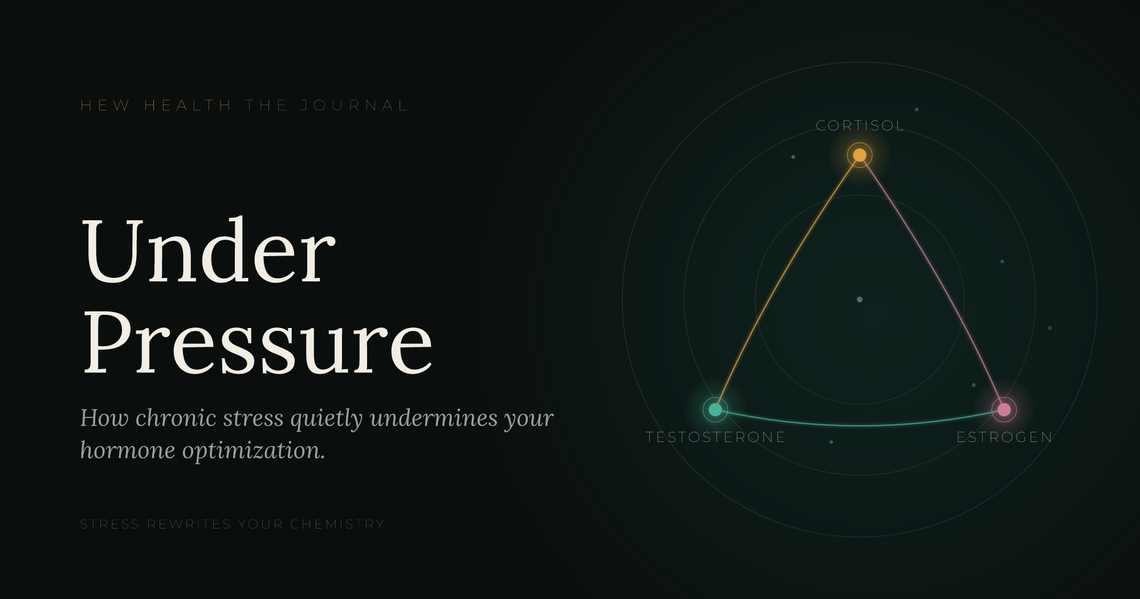
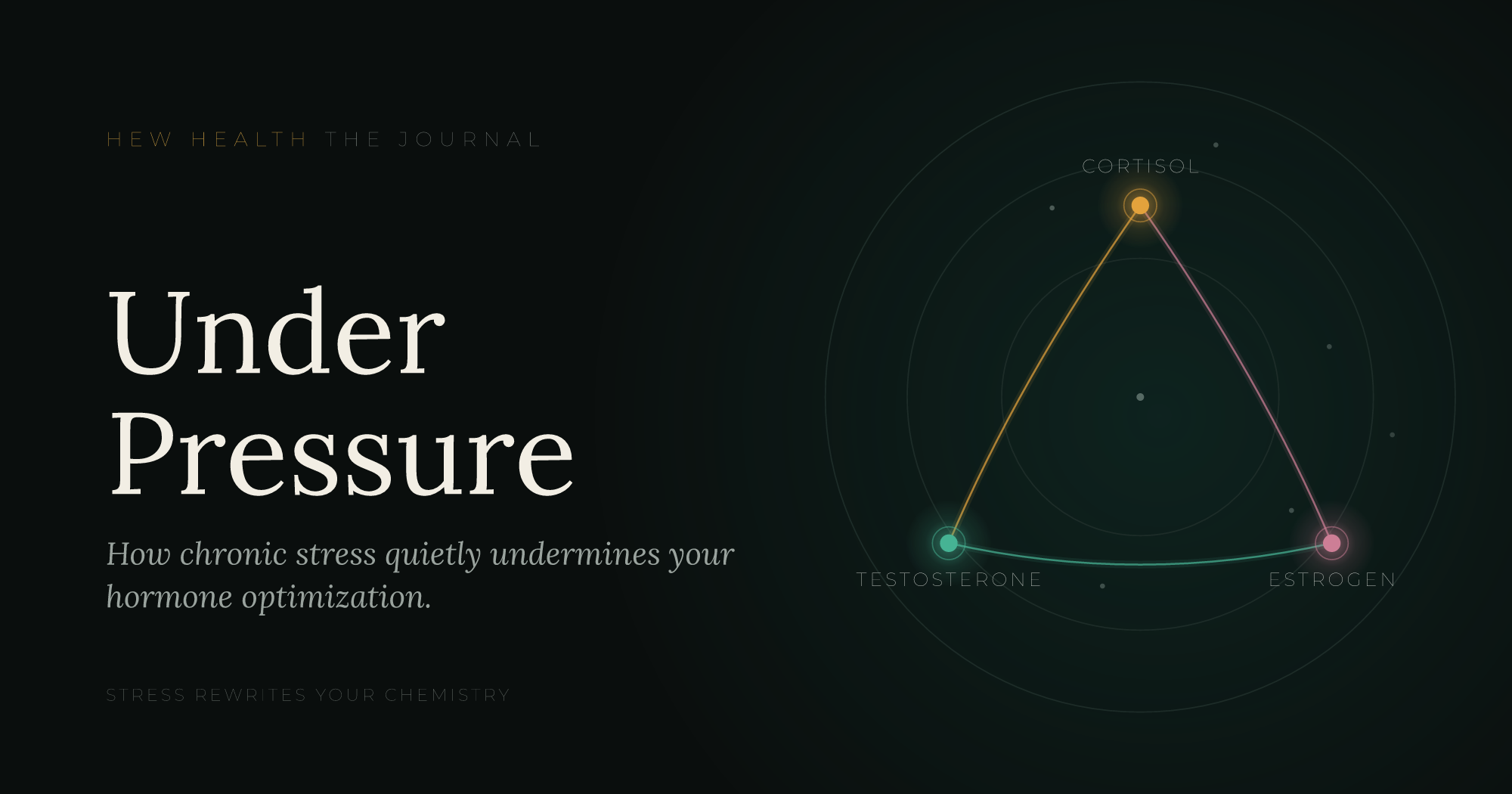
More often than not, the missing piece is cortisol. Chronic stress physiology doesn't just sit alongside your sex hormones. It actively rewrites how they behave. If we ignore that when we design a hormone optimization plan, we get half a result.
The Shared Raw Material
Cortisol, estrogen, progesterone, testosterone, and DHEA all begin as cholesterol. From there, the adrenal glands and gonads convert precursors through a series of enzymatic steps into whichever hormone the body is calling for at that moment. Progesterone, for example, sits upstream of cortisol as a precursor along one branch of that pathway.
You'll sometimes hear this described as "pregnenolone steal" or "cortisol steal," the idea that stress literally siphons hormones away from sex-hormone production. The truth is more nuanced. The body doesn't run one central assembly line where cortisol elbows progesterone off the belt. Steroid synthesis happens in different tissues with tissue-specific enzymes. But the underlying observation clinicians made decades ago still holds: patients under sustained physiological stress tend to run lower in sex hormones and higher in cortisol output, and their symptoms track accordingly.
The mechanism is less about theft and more about signaling. Chronic stress changes how the hypothalamus talks to the pituitary, which changes how the pituitary talks to the ovaries and testes. The whole conversation gets quieter.
What Cortisol Actually Does to Sex Hormones
When cortisol runs high for weeks or months, a few things happen that matter for anyone considering hormone optimization.
First, elevated cortisol suppresses gonadotropin-releasing hormone (GnRH) at the hypothalamus. Less GnRH means less LH and FSH, which means the ovaries and testes get a weaker signal to produce estradiol, progesterone, and testosterone. This is why women in high-stress periods sometimes skip cycles, and why men going through prolonged burnout often see their morning testosterone drift downward.
Second, cortisol increases sex hormone-binding globulin (SHBG) in many patients. SHBG binds testosterone and estradiol tightly, pulling them out of the free, biologically active pool. Total testosterone might look fine on a lab report while free testosterone tells a different story. I see this constantly in stressed executives who assume their fatigue is age-related.
Third, cortisol antagonizes progesterone at the receptor level. Progesterone and cortisol compete for some of the same binding sites, so a patient with high cortisol may feel progesterone-deficient even at reasonable levels. This is part of why perimenopausal women describe stress as making every hormonal symptom worse in a nonlinear way.
Fourth, sustained cortisol drives insulin resistance and visceral fat accumulation. Visceral fat is metabolically active tissue that converts testosterone into estradiol via aromatase. In men, that shift contributes to lower testosterone and higher estrogen. In postmenopausal women, it can create estrogen dominance patterns even without ovarian production.
Why This Matters for Hormone Optimization
Here's the practical implication: if we prescribe testosterone, estradiol, or progesterone without addressing cortisol, we're often chasing a moving target. The patient may feel better initially, then plateau. Or they may need escalating doses to achieve the same effect. Or they may develop side effects that seem disproportionate to the dose.
In our practice, we screen cortisol patterns before finalizing an optimization protocol whenever the clinical picture suggests it. A single morning serum cortisol is almost useless on its own. What tells us something is a four-point salivary or urinary cortisol curve across the day, ideally with cortisol metabolites so we can see both production and clearance. A patient whose cortisol is flat in the morning and elevated at 10 p.m. has a very different problem from one whose cortisol spikes at 6 a.m. and crashes by noon, even if their 24-hour totals look similar.
Those patterns change how we sequence treatment. For someone with a flattened curve and clear HPA axis dysregulation, we often stabilize sleep, circadian rhythm, and stress load for six to eight weeks before adjusting sex hormone doses. Otherwise we're layering optimization onto a foundation that keeps shifting.
The Signs I Watch For
Patients rarely walk in saying "I think my cortisol is dysregulated." They describe patterns that, taken together, point there:
- Wired but tired at bedtime, then a second wind around 10 or 11 p.m.
- Waking at 3 or 4 a.m. with the mind racing, unable to get back to sleep
- Needing caffeine to function until noon, then crashing mid-afternoon
- Weight settling around the abdomen despite consistent exercise
- Shorter fuse than usual, tearfulness or irritability out of proportion
- Increasingly severe PMS or perimenopausal symptoms during high-stress months
- Reduced exercise tolerance, longer recovery times, nagging injuries
- Loss of morning erections in men, or vanishing libido in both sexes, even on optimization protocols
Any three or four of these clustered together deserve a closer look at the HPA axis.
What Actually Moves the Needle
Cortisol responds to inputs. Some are unglamorous and free. Others involve targeted supplementation or medication. The order matters.
Sleep is the single largest lever. A patient who consistently sleeps six hours or less will have elevated evening cortisol no matter what supplements they take. We work on sleep architecture first: consistent wake time, morning sunlight exposure within thirty minutes of rising, no alcohol within three hours of bed, cool bedroom, and for perimenopausal women, often a bedtime dose of oral micronized progesterone which has genuine sedative properties through its GABA-active metabolites.
Training load is the second lever. Endurance athletes and CrossFit enthusiasts in their forties and fifties are frequent offenders. Cortisol responds to volume more than intensity. Two hard sessions and three easier ones usually beats five hard sessions, and the hormone panel tends to confirm it within eight to twelve weeks.
Alcohol is worth naming directly. Two glasses of wine most nights will keep cortisol elevated overnight, blunt REM sleep, and raise estrogen through effects on liver clearance. Patients often don't want to hear this. It's still true.
Beyond lifestyle, adaptogens like ashwagandha and rhodiola have reasonable data for modulating perceived stress and cortisol output in mildly dysregulated patients. Phosphatidylserine can help lower elevated evening cortisol in specific cases. For patients with more significant HPA dysfunction, we sometimes use low-dose DHEA to support the adrenal-gonadal axis, monitored with labs.
Putting It Together
When cortisol and sex hormones are addressed together rather than sequentially, patients tend to feel the difference within a couple of cycles. Sleep deepens. The 3 a.m. wake-ups fade. Body composition starts responding to the work they were already doing. Libido returns in a way that testosterone alone rarely restores if the stress axis is still noisy.
The lesson I've taken from twenty-plus years of doing this: hormones are a system, not a set of independent dials. Optimizing estradiol without looking at cortisol is like tuning a piano in a room with the windows open. You can get the notes right for a moment, but the weather keeps changing them.
If you've been on an optimization protocol and something still feels off, or if you're considering hormone optimization and want a plan that accounts for stress physiology from the start, reach out to our team to schedule a consultation. We'll look at the whole picture.
Related from Hew Health