What the Concierge Standard Means for Hormone Optimization: A Closer Look at Personalized Care at Hew Health
Most people who walk into our practice asking about hormones have already been somewhere else first. They've had a ten-minute visit, a single testosterone or estradiol number pulled from a standard panel, and either a prescription pad or a shrug. Some were told their labs were "normal" while they felt anything but. Others were started on a protocol that never got adjusted, no matter how they responded. That gap between what conventional care delivers and what a person actually needs is where concierge medicine earns its keep.
Hormone optimization is one of the clearest examples of why the concierge model exists. It requires time, real conversation, careful lab interpretation, and a willingness to revisit decisions as your body responds. None of that fits neatly into a seven-minute appointment slot.
Why Hormones Demand More Than a Standard Visit
Hormonal health is not a single number on a lab report. Testosterone doesn't act alone, and neither does estradiol, progesterone, thyroid, cortisol, or DHEA. These molecules interact with each other, with your metabolism, with sleep architecture, with inflammation, and with how your liver is clearing what you take in. A patient with a testosterone level of 450 ng/dL may feel excellent, while another at 650 may feel exhausted, because the free fraction, SHBG, thyroid function, and cortisol rhythm all shape how that hormone is actually experienced.
When we evaluate hormones, we're looking at a system. That takes a longer intake, a broader lab panel, and a clinician who has the time to sit with the results and think. In a rushed visit, the temptation is to treat the number. In concierge practice, we treat the person the number came from.
What the Concierge Standard Actually Looks Like
People hear "concierge" and sometimes picture a lounge with better coffee. The real distinction is structural. Our physician panels are small by design, which means longer visits, direct access, and continuity that doesn't reset every time you call.
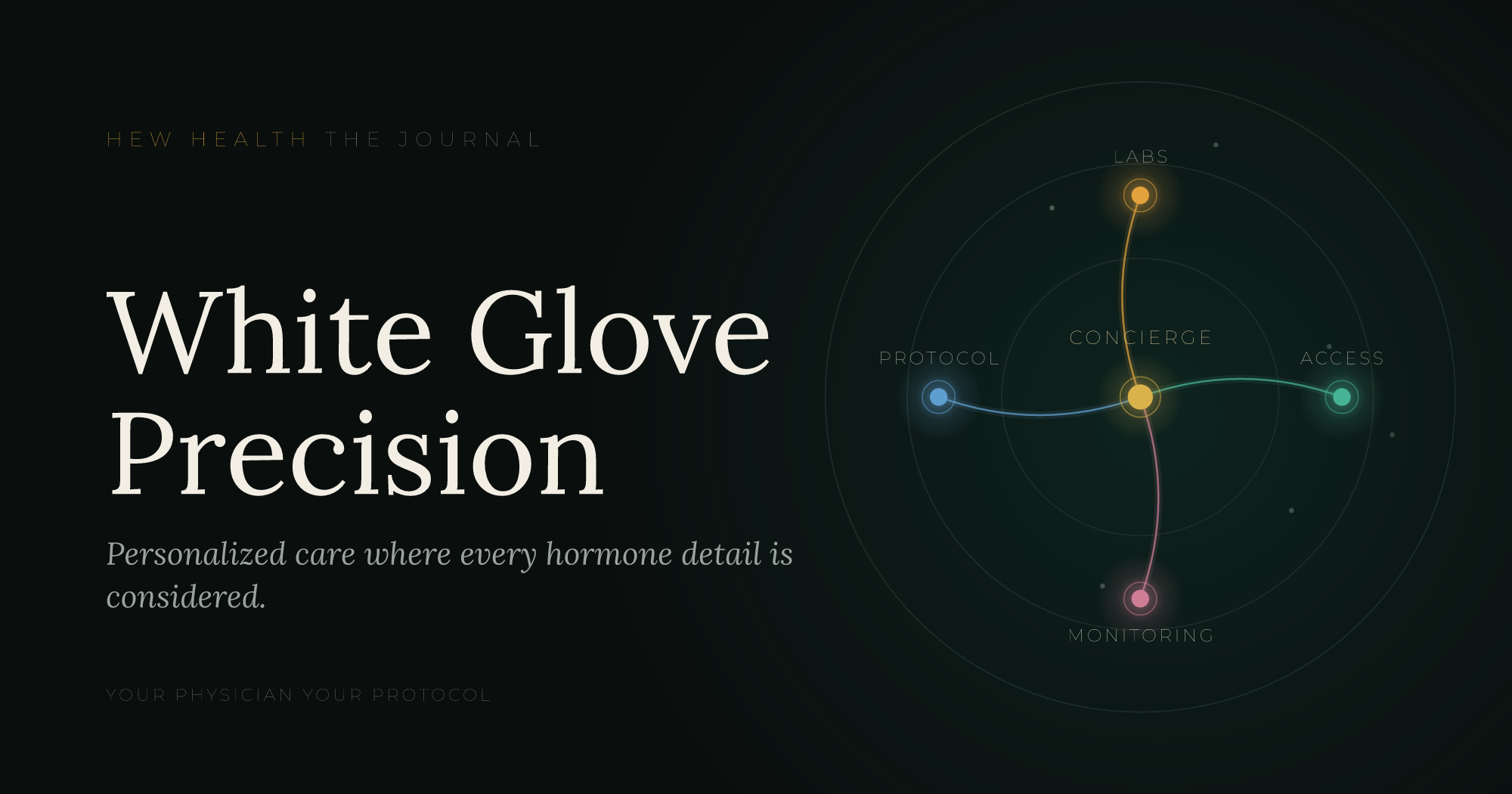
For hormone optimization specifically, that structure translates into a few concrete things you can expect from us:
- A first visit that runs 60 to 90 minutes and covers your history in the kind of depth that actually surfaces the drivers of your symptoms.
- Laboratory work that goes well beyond a basic hormone panel. We typically look at free and total testosterone, estradiol (sensitive assay for men), SHBG, DHEA-S, a full thyroid panel including free T3 and reverse T3, a complete metabolic picture, inflammatory markers, and iron studies. In women, timing of the cycle matters, and we plan draws accordingly.
- Protocols built around your physiology and your goals, not a template. Two men the same age with similar total testosterone may end up on quite different regimens depending on SHBG, hematocrit, fertility considerations, and lifestyle.
- Direct access to your physician between visits. If something changes at week three, you don't wait until month three to talk about it.
- Deliberate follow-up. We recheck labs on a schedule that reflects the protocol, and we adjust. This is the piece most patients tell us was missing before.
Personalization Is a Practice, Not a Slogan
Personalization gets used loosely in medicine. In hormone care, it has a specific meaning. It means the delivery method (injection, cream, pellet, oral, patch) is chosen based on your absorption, your schedule, and how your body handles a given route. It means dosing is titrated, not fixed. It means we consider whether an aromatase inhibitor is genuinely warranted or whether it's being reached for reflexively. It means, for perimenopausal and postmenopausal women, that progesterone, estradiol, and sometimes testosterone are weighed together, and that the conversation includes bone density, cardiovascular history, breast health, and how you actually want to feel day to day.
In our practice, we often see patients who were placed on a hormone protocol years ago and never had it revisited. Bodies change. Weight shifts, sleep changes, stress moves, medications get added. A protocol that fit at 45 may be wrong at 52. Part of the concierge standard is the assumption that your care is a living thing, not a decision made once and defended forever.
Safety, Monitoring, and Honest Expectations
Good hormone care is also cautious hormone care. Testosterone optimization can raise hematocrit, and we watch for it. Estradiol therapy in women carries considerations that depend on your personal and family history. Thyroid adjustments affect cardiac rhythm and bone. None of this is a reason to avoid treatment when it's appropriate. It is a reason to do it with a clinician who has the bandwidth to monitor properly and the honesty to tell you when a symptom you're chasing is unlikely to respond to a hormone change.
We try to be straightforward about what hormone optimization can and cannot do. It can meaningfully improve energy, sleep quality, mood stability, libido, body composition trajectory, and cognitive clarity for many patients whose labs and symptoms line up. It is not a solution for problems that are actually about sleep debt, unmanaged stress, undertreated depression, or nutritional gaps. A concierge physician has time to sort that out with you rather than defaulting to a prescription.
How Hormone Care Fits Into the Larger Picture
Hormones don't exist in isolation from the rest of your health, and neither should the physician managing them. In our model, the same clinician who oversees your hormone protocol also knows your cardiovascular risk profile, your family history, your training habits, and what's happening at work. When we talk about your estradiol level, we're talking about it in the context of your last lipid panel, your blood pressure trend, and how you slept last month. That integration is difficult to achieve when your hormone care lives at one clinic and your primary care lives at another.
This is also where Weight Management, nutrition, and hormone optimization tend to overlap in real life. Metabolic health influences hormone levels, and hormone levels influence metabolic health. Treating them as separate projects usually slows both down.
What to Expect If You Start With Us
A typical path looks something like this. We begin with a thorough conversation and a comprehensive lab draw. You come back for a dedicated review visit, where we walk through the results together and discuss whether a hormone protocol is indicated, what the options are, and what the trade-offs look like for you specifically. If we move forward, we set a monitoring schedule, usually with a recheck at six to eight weeks and again at three to four months, then at intervals that make sense for your protocol. Between visits, you can reach us directly.
That rhythm (assess, adjust, reassess) is unremarkable in the way that all good medicine is unremarkable. It just requires time, which is what concierge care is designed to protect.
If you're considering hormone optimization, or you've been on a protocol that no longer feels right, we'd be glad to talk. You can reach out to our team to start a conversation about whether our approach fits what you're looking for.
Related from Hew Health