Concierge as Methodology, not Marketing
On a word that has been claimed by every spa, supplement shop, and direct-pay clinic in the country — and what it actually requires of a practice.
— Matthew Koucky · Hew Health · Vol I, Issue 01
The word concierge has had a difficult decade. It used to mean something specific in medicine: a practice that did not bill insurance, kept its patient panel small enough to know the people in it, and was available outside of regular hours because that is when most of life happens. Somewhere along the way it became a marketing term, then a price band, then a category claim that any practice could make if they charged enough.
I have been on the other side of the desk in plenty of those clinics. I know what a real one feels like and what a counterfeit one feels like, and I built this practice in part to make the difference explicit.
What concierge is not
It is not the price. A practice can charge a premium and still run on the same fifteen-minute cadence as any urgent care.
It is not the décor. The marble countertop in the lobby has no bearing on what happens in the exam room.
It is not even, by itself, the absence of insurance billing. Cash-pay is necessary for what we do, but it is not sufficient. There are cash-pay practices that move patients through faster than insurance ones, because cash-pay can run on volume too if the operator wants it to.
What concierge is
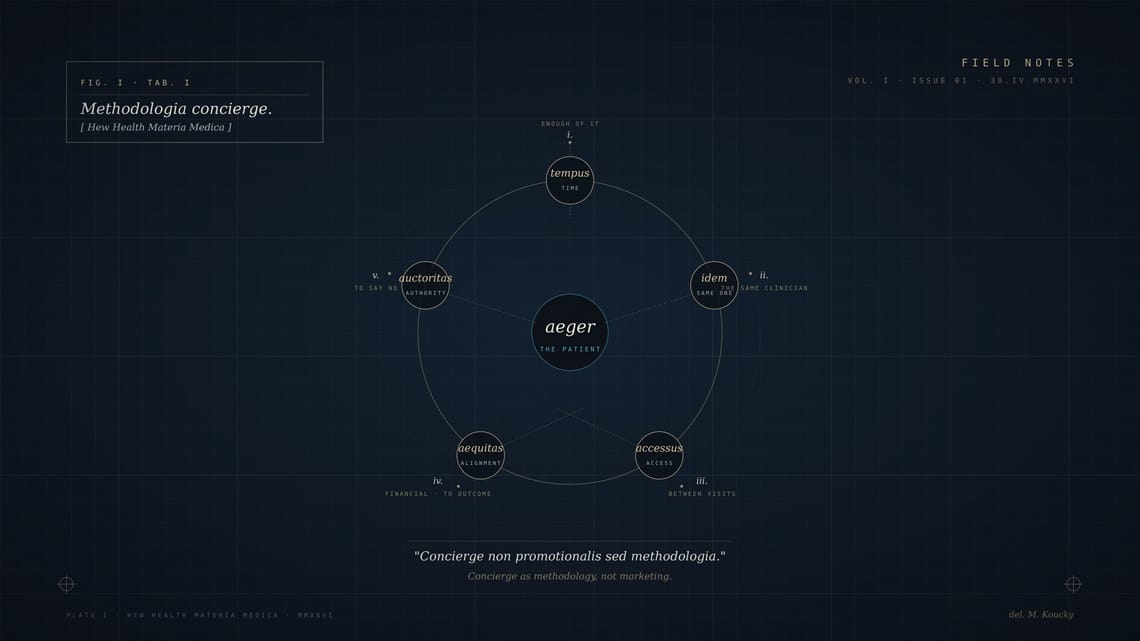
I will give you the working definition we use internally. A practice is concierge to the degree it can answer yes to all of the following:
Does the same clinician see the patient at every visit? Not the same practice. The same person. If a patient has been on our service for a year and tells me a story about something that happened in February, I should remember February.
Is there enough time in each visit for the thing the patient came in for AND the thing they didn't know they came in for? The second one is where the actual medicine lives. It does not happen in fifteen minutes.
Can the patient reach a clinician between visits? Not a triage line. A clinician. Within a reasonable window, by a channel the patient finds tolerable. If the answer is "they can leave a voicemail and someone will call them back next Tuesday," the practice is not concierge.
Is the financial model aligned with the patient outcome? When we are paid per service, we have an incentive to provide more services. When we are paid per visit, we have an incentive to schedule more visits. When we are paid annually, our only incentive is to keep the patient. Concierge models point at that last one.
Does the clinician have the time and the authority to say no? "No, we are not going to add another medication for that." "No, we are not going to escalate dosing this quarter." "No, that supplement does not have the evidence base it claims." Saying no is expensive in a fee-for-service model. It is cheaper, and easier, in ours.
The math of a small panel
The single hardest decision a concierge practice makes is the size of its patient panel. Too small and the model is not financially viable. Too large and the model is concierge in name only.
The number that works for our discipline, in our experience, is in the low hundreds per clinician — not the thousands a traditional primary care practice runs. That is the number that allows the same clinician to see the same patient, to remember what happened in February, to read the labs themselves rather than letting an algorithm do it.
It is also the number that means we cannot serve everyone who wants to be served, and we are honest about that on the first call.
Why we built it this way
I started Hew Health because I wanted a practice that I would want as a patient. That is the entire founding logic. Not market opportunity, not differentiation strategy. The practice I wanted to be in.
What I wanted, when I was thinking about it as a patient, was someone who knew me, had time for me, was paid in a way that did not warp the conversation, and would tell me when I was wrong. The market opportunity turned out to be that not many people are building that. I would have preferred to be one of many. We are working on it.
⁂
Tags: Practice Philosophy · Concierge Medicine · Founder Notes · Methodology
Author: Matthew Koucky
Category: Method
Read time: ~6 min
Field Notes is the editorial blog of Hew Health, a concierge medicine practice publishing from Destin and Orlando. Read across forty-seven states.